Learn how to accurately translate Romanian language video and text. This guide covers the best tools, workflows, and editing tips for professional results.
A Practical Guide to Translate Romanian Language Content
Translating Romanian content effectively requires more than just machine-powered word swapping. The key to solving this challenge is a hybrid approach: use AI transcription and translation for speed, but always rely on a human touch to refine the nuances, especially for video content where accessibility and clarity are paramount. This guide provides a practical workflow to solve the real problem of creating accurate, natural-sounding Romanian translations that connect with your audience.
Your Smart Start to Romanian Translation
Kicking off a translation project can seem daunting, but a structured workflow makes it manageable and effective. Whether you're repurposing a training video for a Romanian team or creating subtitles to make your content accessible, the goal is the same: produce a translation that is not only accurate but also feels natural to a native speaker. For a language as rich as Romanian, this is crucial for clear communication.
The process boils down to a few key stages. First, prepare your source material. For video or audio, this means generating an accurate transcript. A tool like YoutubeToText is perfect for this, efficiently converting spoken words into clean, usable text. From there, you translate, and finally, you review.
The Foundation of a Good Translation
A great Romanian translation is about more than just swapping words; it's about solving the problem of cultural and contextual gaps that automated tools often create.
Here’s a workflow designed to solve that problem:
- Get an Accurate Transcript: If you're translating audio or video, a perfect transcript is your foundation. It's the essential first step for accessibility and accurate repurposing.
- Use Smart Translation Tools: Modern AI translation services are excellent for creating a solid first draft, dramatically improving productivity.
- Polish with a Human Expert: This is the most critical step. A native speaker or fluent professional reviews the translation to fix awkward phrasing and ensure it sounds completely natural, solving the "robotic translation" issue.
This simple three-part process is your roadmap to getting it right.
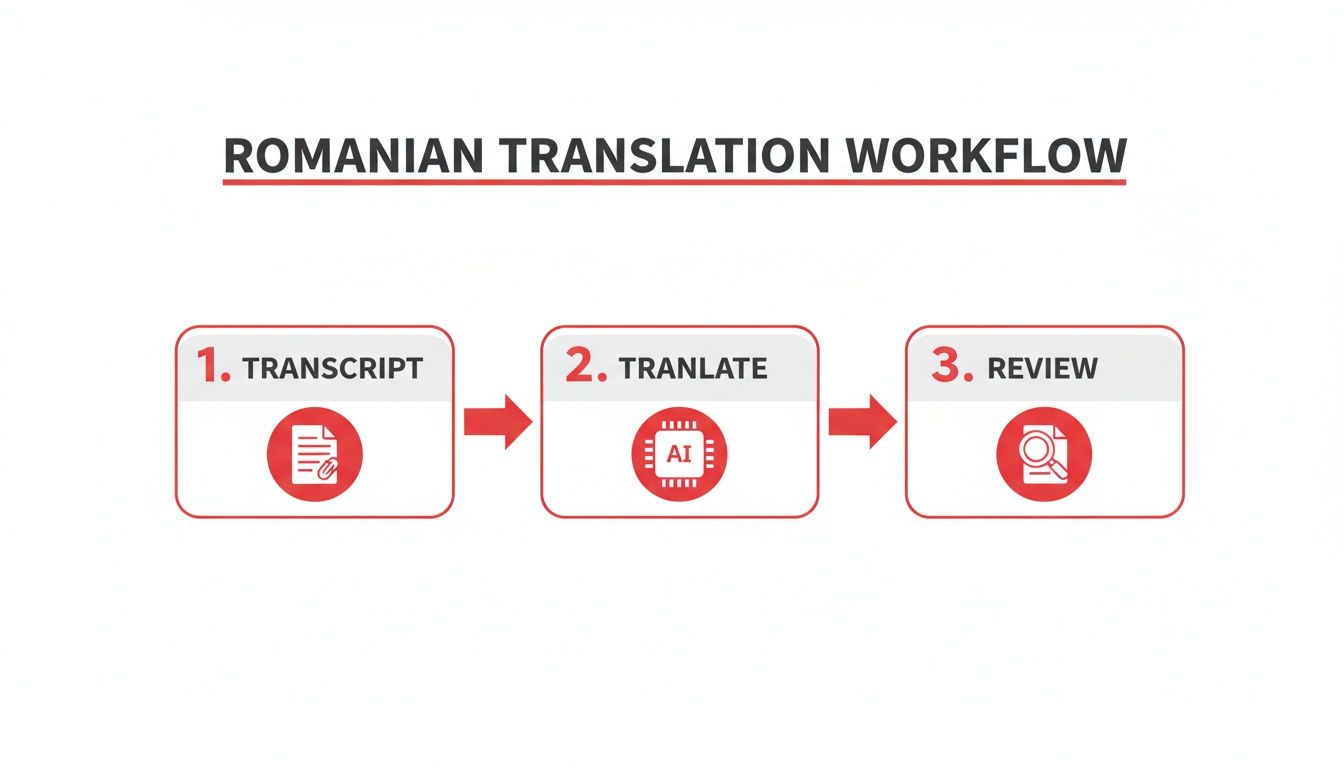
This transcribe, translate, and review method keeps your projects efficient without sacrificing the quality needed for effective communication.
To give you a clearer picture, here's a quick summary of the workflow.
Romanian Translation Workflow at a Glance
This table breaks down the essential stages for translating Romanian content, from preparing the source material to the final quality check.
| Stage | Key Action | Tool/Method |
|---|---|---|
| 1. Preparation | Create a clean, accurate transcript from audio/video. | Automated transcription services like YoutubeToText. |
| 2. Initial Translation | Generate a first-draft translation of the source text. | AI-powered translation tools (e.g., DeepL, Google Translate). |
| 3. Human Review | Edit for fluency, cultural context, and accuracy. | A native Romanian speaker or professional translator. |
Following these stages in order ensures you cover all the bases for a high-quality, professional-sounding translation that solves your communication needs.
Why Romanian Requires Careful Handling
The Romanian language isn't static; it's alive and constantly changing. Back in 2021, its standard lexicon had about 180,000 words. What's more, an estimated 3,600 new words are added every year from other languages or through new coinages. This dynamic nature makes context, slang, and modern phrasing incredibly important for accurate translation. You can read more about the dynamics of the Romanian language to get a better sense of its character.
A wooden, word-for-word translation sticks out like a sore thumb. The goal is fluency. You want the final text to read as if it was written by a native speaker from the start, perfectly capturing the original's tone and intent. That means going far beyond a simple dictionary swap.
Turn Romanian Videos Into Usable Text
Before you can translate a Romanian video to create accessible subtitles or repurpose its content, you must solve a critical first problem: getting an accurate text version of everything that's said. This transcription step is the most important part of the process, because a flawed transcript will inevitably lead to a flawed translation, undermining your entire project.
The goal here is a precise, time-stamped document from the audio. This isn't just about writing down words; it’s about capturing them correctly, which can be a real challenge with the natural speed of spoken Romanian. For a task like this, you might use a specialised tool like Colossyan's video translator, which is built to handle this kind of work.
Starting With an Accurate Transcript
Imagine you're translating a business presentation for a new market. If your automated transcript confuses "costuri anuale" (annual costs) with "coaste anuale" (annual ribs), the meaning is completely lost. This sounds absurd, but it highlights the kind of critical errors that can derail a project. Starting with a clean, accurate text file is the only way to prevent such problems.
While automated tools provide a fantastic head start—often with impressive accuracy—your role is to take that first draft and refine it into a perfect source document, boosting your productivity and ensuring quality.
Here's a simple productivity hack I always use: carefully check the first few minutes of the generated transcript against the video. This quick spot-check helps you catch recurring mistakes, like a name or technical term the AI consistently misinterprets. Solving these issues early on will save you hours of work later.
Practical Steps for a Clean Transcript
Creating a high-quality transcript is more than just a single click. It requires hands-on attention to detail to ensure it's a reliable foundation for translation.
Here’s a practical workflow using a tool like YoutubeToText:
- Generate the First Draft: Paste your video link into the tool to generate an automated transcript. This fast process gives you a text file complete with timestamps, ready for review.
- Listen for Regional Accents: Romanian has several distinct regional accents. An AI might stumble over dialect-specific words, so listen closely and make manual corrections to ensure accuracy.
- Double-Check Key Terminology: Pay extra attention to names, brands, and any technical jargon. Proper nouns are a common weak spot for AI, so verify these against the audio to avoid embarrassing errors.
The straightforward interface makes it easy to kick off the transcription, which is the essential first step before you can translate Romanian into English or any other language.
Once you have this polished transcript, you're ready to move on to the actual translation.
The quality of your final translation is directly tied to the quality of your initial transcript. Time spent perfecting the source text is an investment, not a cost—it prevents a cascade of errors down the line.
Choosing the Right Romanian Translation Tool
Once you have a clean transcript, it’s time to solve the translation puzzle. How you translate Romanian language text depends on your goals, budget, and the quality required for your project, whether it's for internal training, public-facing content, or accessibility.
The fastest route is using free AI-powered tools like Google Translate or DeepL. They are incredibly fast and free, making them a great solution for getting the general idea of a Romanian news article or understanding a casual Youtube video.
However, for professional use cases like creating accurate subtitles or repurposing content for marketing, a machine-only translation often fails to solve the problem of nuance and cultural relevance. This is where professional human translators are essential. Hiring a native Romanian speaker ensures you capture the precision and cultural context that AI cannot yet replicate. This is the gold standard for any content where your brand’s reputation is on the line.
Machine Translation Versus Human Expertise
The choice between an AI tool and a human translator is a balance of speed, cost, and quality. AI has advanced significantly; Google Translate, for example, now uses more sophisticated models to grasp idioms, a major step up from older, word-for-word methods.
Even with these improvements, machine translations can still sound stiff. Language is intertwined with culture, something a human understands instinctively. A person knows that a literal translation is rarely the best solution, especially for creative content where a natural flow is paramount. As you weigh your choices, it can be helpful to explore top translation software options for business to find a tool that fits your needs.
For projects where you need both speed and accuracy, a hybrid approach is often the perfect solution. This workflow, called Machine Translation Post-Editing (MTPE), uses AI for the initial heavy lifting, and then a human expert refines the text. This boosts productivity while ensuring the final result sounds natural.
Finding the Right Balance for Your Project
So, how do you decide? It all comes back to the problem you're trying to solve. Are you a student who just needs to quickly understand a lecture for your notes? An AI translation will likely suffice. But if you’re a business creating subtitles to make a promotional video accessible to a Romanian audience, investing in a professional translator or a solid MTPE workflow is essential for success.
Getting the initial text right is the first crucial step, and you can learn more about that in our guide to finding the best video to text converter available.
To make the decision easier, it helps to see the options laid out side-by-side.
Comparing Romanian Translation Methods
| Method | Typical Cost | Speed | Accuracy | Best For |
|---|---|---|---|---|
| Free AI Tools | Free | Instant | Low to Medium | Getting the general meaning, personal use, informal content. |
| Hybrid (MTPE) | $-$$ | Fast | High | Subtitles, internal business docs, content needing a quick but accurate turnaround. |
| Professional Human | $$-$$$ | Slower | Very High | Marketing materials, legal documents, public-facing content where quality is critical. |
Ultimately, weighing these factors will help you pick the right approach to translate your Romanian content with confidence, ensuring the final result matches your project’s needs perfectly.
How to Polish Your Romanian Translation
An automated translation is a fantastic productivity booster, but it's rarely the final product. The real transformation happens during post-editing, where you take the machine-generated text and polish it. This is how you solve the problem of "robotic" translation, turning a literal text into something that feels completely natural to a native Romanian speaker.
This step is about far more than fixing grammar mistakes. It’s about capturing the original tone, intent, and cultural nuances that AI tools miss. Without this human touch, your content can feel awkward or, worse, miscommunicate your message, failing to connect with your intended audience.
Go Beyond Literal Word Swapping
One of the classic pitfalls of automated tools is their tendency to translate idioms literally. A phrase like "it's raining cats and dogs" becomes nonsense in Romanian if translated word-for-word. Your first task is to identify these awkward phrases and replace them with natural-sounding equivalents that capture the meaning, not just the words.
Take the English idiom "to steal someone's thunder." A direct translation would be meaningless. A human editor, however, would know to use a Romanian equivalent like "a fura laurii cuiva" (to steal someone's laurels), which perfectly conveys the idea. Having your original transcript handy is a lifesaver here, allowing you to cross-reference and ensure the core message remains intact.
"I want it to be translated into good English, not a very wooden literal translation, but fluent so it’s easy for Americans to read." - Dr. Michael Jones, Fulbright Scholar.
Dr. Jones was discussing the challenge of translating complex Romanian philosophy, but the principle is universal. The goal is always fluency and naturalness, solving the problem of readability for the target audience.
Create a Practical Post-Editing Checklist
To make your review process more structured and productive, use a checklist. This simple tool ensures you consistently catch the most common errors that machine translation introduces when you translate Romanian language content.
Here are a few key areas to focus on during your review:
- Idioms and Colloquialisms: Have any expressions been translated literally? Find the right local equivalents that people actually use.
- Formality and Tone: Tweak the language to match the context. Is this a formal business document or a casual travel vlog? The choice of words must reflect that.
- Grammatical Peculiarities: Keep a sharp eye on Romanian-specific grammar, like correct verb conjugations and the proper use of diacritics (ă, â, î, ș, ț). AI often fumbles these crucial details.
- Sentence Flow and Rhythm: Read the translation out loud. It’s a simple but incredibly effective productivity trick for spotting awkward phrasing and sentences that don't flow well.
Fine-Tuning for Your Audience and Format
The final polish also depends on where you'll repurpose the content. If you're creating subtitles, for instance, conciseness is key to solving the accessibility challenge. The message must be clear and easy to read in the few seconds it’s on screen, which often means simplifying sentences. If you need help with this, you can learn more about formatting in our guide on how to convert TXT files to SRT.
Ultimately, polishing your translation bridges the gap between machine output and human expectation. It's an investment of time that pays off by making your content more credible, engaging, and professional. This careful review is what separates a mediocre translation from one that truly connects with and solves a problem for a Romanian-speaking audience.
Navigating Romanian Dialects and Nuances
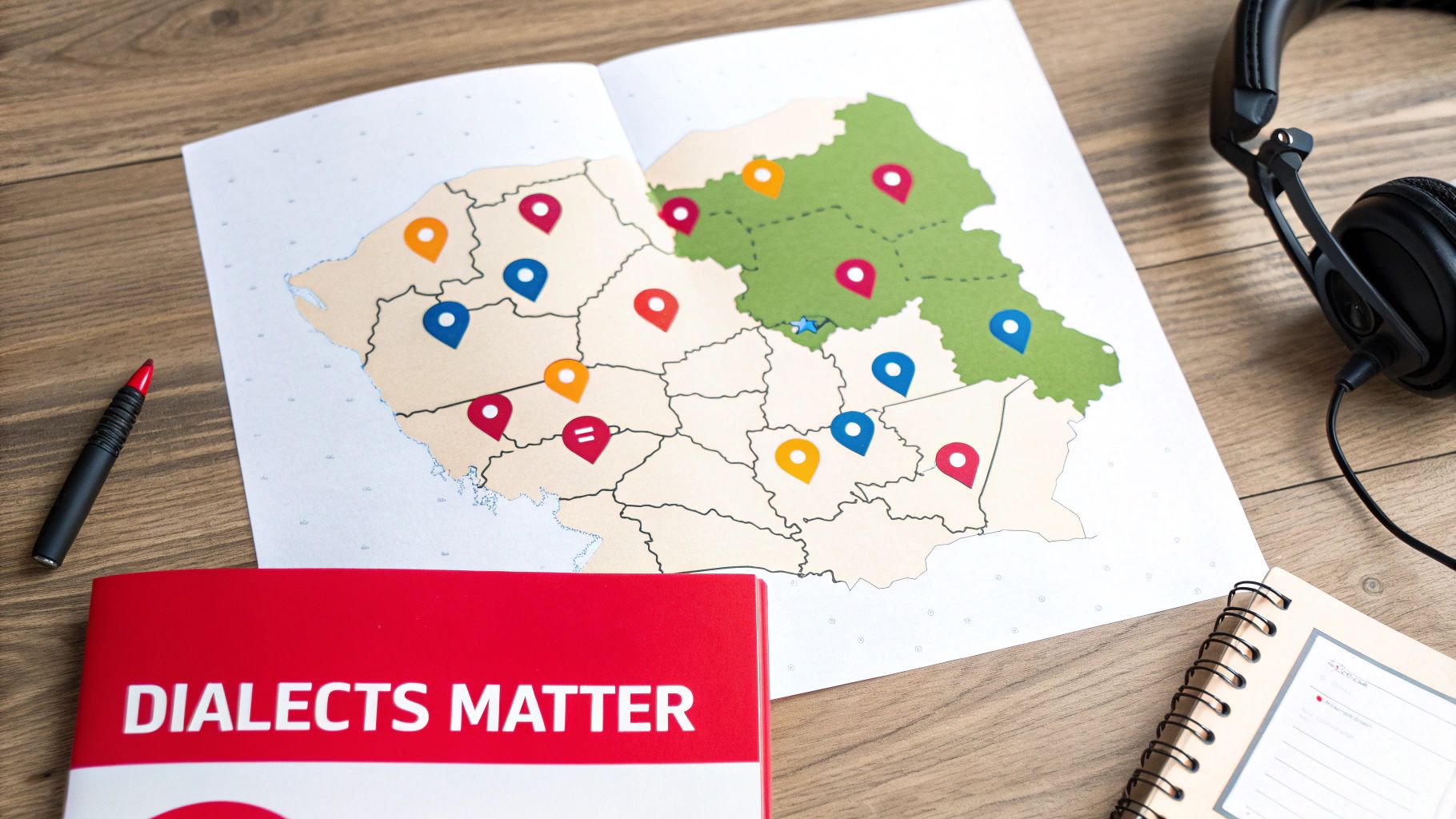
Before you translate Romanian language content, you must address a critical detail: Romanian is not a monolithic language. The speech in Bucharest differs from that in Transylvania or across the border in Moldova. These regional variations are more than just accents; they are dialects that can easily confuse automated translation tools, which are almost always trained on standard, formal Romanian.
These differences include unique vocabulary, slight grammatical variations, and local sayings that a standard model won't recognize. A common word in the Moldavian dialect might be unknown to someone from Wallachia, leading to a translation that feels unnatural or incorrect. Solving this problem is key to authentic communication.
Ignoring these subtleties means missing an opportunity to connect. A translation that respects regional flavor feels more authentic and shows your audience you've done your homework. These small details build trust and prevent the jarring mistakes that can instantly disengage a reader or viewer.
Identifying the Right Regional Variant
To ensure your translation speaks your audience's language, you first need to identify which regional variant you're working with. This is a crucial step in creating accessible and effective content.
Here are a few practical ways to solve this challenge:
- Check the Source: Where did the content originate? A video from Chișinău will almost certainly use the Moldavian dialect, which has noticeable Russian influences.
- Listen for Specific Words: Certain words are clear indicators. For example, in Moldova, "harbuz" means watermelon, while in most of Romania, the word is "pepene."
- Ask a Native Speaker: When in doubt, this is the most reliable solution. A native speaker can often identify a dialect within a few sentences.
Doing this upfront work is the key to producing a translation that truly resonates.
Distinguishing Related Languages Like Aromanian
The situation becomes more complex with closely related but distinct languages. Take Aromanian, for instance. To an untrained ear, it might sound like a Romanian dialect, but it is a separate Eastern Romance language with its own grammar and vocabulary. Treating it as Romanian will produce a nonsensical translation.
This is especially critical because many of these related languages are endangered, a serious accessibility and cultural preservation problem. Aromanian is facing a rapid language shift. In North Macedonia's 2021 census, 8,714 people identified as ethnically Aromanian, but only 3,151—just 36% of them—claimed it as their mother tongue. You can read more about the challenges facing endangered languages like Aromanian in recent research.
A Note on Cultural Sensitivity: A good translation respects these linguistic boundaries. Mistaking Aromanian for a Romanian dialect isn’t just a technical error; it's a cultural misstep that can seriously damage your content's credibility and accessibility.
Ultimately, understanding the specific linguistic context of your source material is a non-negotiable step. It's what separates a clumsy, word-for-word translation from one that communicates your message with genuine respect and accuracy.
Got Questions About Romanian Translation? Let's Unpack Them
When diving into a Romanian translation project, several questions always come up. Whether you're trying to translate Romanian language text to reach a new market or creating subtitles to improve video accessibility, getting clear answers upfront is a huge productivity booster. Let's solve some of the most common problems.
How Good Are AI Translators for Romanian, Really?
Modern AI tools from companies like Google have become surprisingly effective with Romanian. They have evolved beyond literal translations and can now often interpret context, handling idioms and casual phrases much better than before. For a quick understanding of an article or an informal email, they are often a sufficient solution.
But here’s the catch: true accuracy goes beyond correct words. It encompasses tone, cultural sensitivity, and natural flow. An AI might produce a grammatically correct translation that still sounds robotic. For anything critical—like marketing copy, legal documents, or your website's homepage—it's best to treat AI output as a first draft that needs human refinement to truly solve the communication problem.
The optimal solution for high-stakes projects is a hybrid approach. Use AI for a fast initial translation to boost productivity, then bring in a native Romanian speaker to refine it. This combines the speed of technology with the irreplaceable nuance of human expertise.
What Should I Expect to Pay for a Professional Translation?
The cost of professional Romanian translation varies depending on the specific problem you need to solve. There's no single price.
Here are the main factors that affect the cost:
- Content Complexity: Translating a simple blog post is far different from a dense technical manual or a legal contract. Specialized content requiring an expert translator will cost more.
- How Fast You Need It: A tight deadline requires a rush job, which usually comes with a higher fee. Planning ahead and allowing for a standard turnaround time will improve your productivity and lower your costs.
- The Level of Service: Do you need a straight translation, or a full package including proofreading, editing, and localization for a specific region? Each additional layer of review adds to the price.
- Translator Experience: A seasoned professional will charge more than a novice, but that investment often buys you higher quality, reliability, and peace of mind.
As a general estimate, expect to pay between £0.08 and £0.20 per word. For a 1,000-word document, your budget would be between £80 and £200. For video subtitles, translators often charge per minute of audio, which can be pricier as it includes the extra step of timing the text to the video.
What Are the Best Practices for Romanian Subtitles?
Creating effective subtitles is an art that solves the critical problem of accessibility. The goal is to make the video easy for a Romanian-speaking audience to understand without overwhelming them.
First, always work from a clean, time-stamped transcript. It's the foundation of good subtitles and a key to productivity in the subtitling process.
Next, focus on readability. Shorter is better. Break long sentences into two or three shorter lines that are easy to scan. A great rule of thumb is to stick to a maximum of 42 characters per line. You also need to give viewers enough time to read them—aim for about one second on screen for every three words.
Finally, ensure the translation captures the speaker's personality and intent. This is where a human editor is invaluable. They can adapt jokes, cultural references, and slang so they resonate with a Romanian audience. This is what makes subtitles feel authentic and engaging, solving the problem of making your content truly accessible and enjoyable.
Ready to create the perfect transcript for your next Romanian translation project? YoutubeToText gives you fast, accurate text from any Youtube video, providing the ideal foundation for high-quality translations and subtitles. Start your project with a clean transcript by visiting the YoutubeToText website.