Learn a proven workflow to translate Romanian into English for video and audio. Go from a raw file to polished subtitles with accuracy and cultural nuance.
How to Translate Romanian into English for Media Content
On the surface, translating Romanian into English seems easy enough. Just drop the text into a free online tool and you're done, right? If only it were that simple. That quick-fix approach almost always spits out translations that are clunky, inaccurate, and completely miss the soul of the original message.
This guide solves that problem. We'll walk you through a practical, step-by-step workflow that leverages AI for speed and human expertise for nuance. This method will help you create accurate, natural-sounding English translations for your audio and video content, boosting your productivity and making your message accessible to a global audience.
Why a Quick Copy-Paste Translation Just Won't Cut It
When you're in a hurry to translate a Romanian audio or video file, reaching for the nearest free tool is tempting. But this method often creates a translation that, while maybe grammatically okay, feels stiff and robotic. It can even completely fail to capture important cultural nuances. The whole point isn't just to swap words; it's to make sure the original intent, tone, and context come through loud and clear in English.
A solid, professional workflow goes way beyond just machine translation. It’s a process that saves you time and prevents rework. It starts by getting a perfect transcript of the original Romanian audio. This clean text becomes the bedrock for the translation, which is then polished by a human editor to make sure it sounds natural and fluent in English. This blend of AI speed and human intuition is how you solve the translation problem efficiently.
The Specific Hurdles of Translating Romanian
Romanian has its own unique quirks that can easily trip up automated translation tools. Its rich vocabulary and complex grammar are notorious for confusing the algorithms, which often leads to some common and predictable mistakes.
- Idioms and Expressions: So many Romanian phrases just don't have a direct one-to-one match in English. A literal translation can sound bizarre. Take "a tăia frunză la câini," which literally means "to cut leaves for the dogs." An automated tool might give you that, but the real meaning is "to waste time."
- Regional Dialects: Like any language, Romanian has different accents and words depending on the region. An automated system can easily get confused by these variations, which leads to errors in both the transcription and the final translation.
- Lexical Richness: The very structure of the language can be a challenge. For instance, recent NLP research has shown that Romanian has a much higher type-token ratio (0.09) than English (0.05). This means it uses a wider variety of unique words in a given text, making it harder for machines to produce high-quality translations. It's a big reason why automated systems often score poorly on accuracy tests. You can dive into the full research about these linguistic challenges if you're curious.
Once you get a handle on these challenges, it’s clear why a simple copy-paste job is never enough. You need a thoughtful, structured process to really capture the essence of the original and create an English version that actually resonates with your audience.
Start with an Accurate Romanian Transcript
Here’s a hard-earned lesson from the trenches: every great translation starts with a flawless transcript. Before you even begin thinking about turning Romanian into English, you need to get the original spoken words down perfectly. Trying to translate directly from an audio file is like building a house on a shaky foundation – it’s just asking for trouble later on.
A clean, precise transcript isn't just a nice-to-have; it's essential for getting professional results. It takes all the guesswork out of the equation and gives your translation tools (or a human editor) a solid block of text to work with. Honestly, if you skimp on this first step, you'll be dealing with a cascade of errors all the way down the line.
Why Automated Transcription Is Your Best First Move
Let's be real, nobody has time to transcribe audio manually. It's a slow, painstaking job. This is where modern AI-powered tools come in, offering a much smarter way to get a text version of your audio or video in minutes, not hours. This is a massive productivity win.
If your content is already on Youtube, a tool like YoutubeToText is built for exactly this purpose. You just feed it the video link, and the software quickly gets to work, converting the speech into a timestamped transcript. For content creators needing to repurpose their work for a wider audience, this is a massive time-saver.
The translation process can be a bit of a minefield, and mistakes often creep in right at the very beginning.
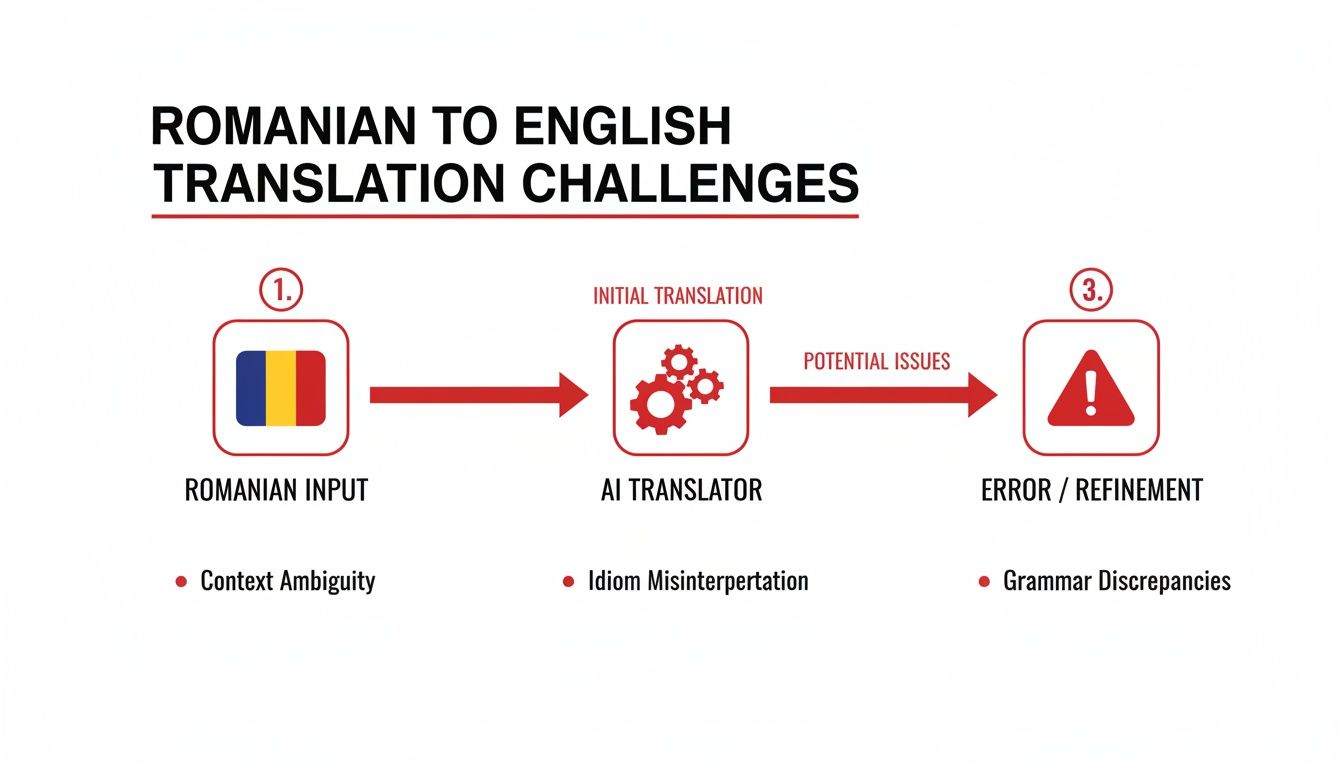
This just goes to show how a small error in the initial text can snowball into a major translation blunder.
Generating Your Romanian Transcript
Getting the transcript is refreshingly simple. With a service like YoutubeToText, you can pull the text directly from a Youtube URL without having to download anything. The AI is pretty good at handling different speakers and can usually pick out speech even when there's a bit of background noise, giving you a clean starting point.
The whole interface is designed for speed. Paste a link, and you’ll have your text in a few moments. And if you're not just working with Youtube videos, it’s worth looking into how an audio file to text converter handles other media formats.
The bottom line: The quality of your final English translation hangs entirely on how accurate your initial Romanian transcript is. Using a dedicated tool saves a huge amount of time and cuts down the risk of errors right from the start.
Once the AI has done its job, it’s time for a quick human review. This is your chance to polish the text and catch any little slip-ups the machine might have made. I always look for:
- Proper Nouns: AI can stumble on names of people, places, or specific brands. A quick check for correct spelling is a must.
- Dialect-Specific Terms: Sometimes regional words or slang can pop up. It's best to swap these for more standard terms that a translation engine will understand.
- Speaker Labels: Make sure the right person is credited with saying the right line.
This final cleanup doesn't take long, but it’s absolutely crucial. It ensures your Romanian source text is as perfect as it can be. With this solid foundation ready, you can confidently move on to the actual translation.
Generate Your First-Draft English Translation
Alright, you've got your clean Romanian transcript. Now it's time for the magic of machine translation (MT). This is where we’ll get the initial English version of your text. Let’s be clear: the goal here isn't perfection. We're aiming for a solid first draft that's about 80% of the way there. Think of it as creating a strong foundation that we'll build upon with human editing.
The tool you pick for this step really matters. You can find dozens of general-purpose translators out there, but their performance can be all over the place, especially for a language pair like Romanian and English. These tools work by crunching massive amounts of text to find patterns, so the quality of the final output really depends on the data they were trained on.
What to Expect from Machine Translation
It’s crucial to go into this with realistic expectations. Machine translation is brilliant for chewing through huge chunks of text and giving you a structurally sound translation in seconds. Where it often falls flat, though, is with the subtle stuff—the nuances that make a language feel alive and authentic.
When translating from Romanian, you should be on the lookout for a few common quirks:
- Literal Translations of Idioms: An MT tool might see "a freca menta" and translate it literally as "to rub mint," completely missing the actual meaning, which is "to waste time."
- Awkward Sentence Structure: Romanian sentence construction is often more flexible than English. A direct, word-for-word translation can produce sentences that sound clunky or put the emphasis in all the wrong places.
- Loss of Cultural Context: Jokes, cultural nods, or specific regional phrases rarely survive a literal translation. They lose their punch and need a more thoughtful, creative adaptation to land with an English-speaking audience.
Think of machine translation as a highly efficient assistant who isn't a native speaker. It gets the core message across perfectly well, but it doesn't have the cultural fluency to make the language truly connect.
The Dynamics of Romanian to English Translation
Adding another layer of complexity is the fact that the Romanian language is a living, breathing thing. Professional services have pointed out that Romanian adopts around 3,600 new words every year, meaning its vocabulary is constantly expanding. This rapid evolution means that MT models need to be updated constantly just to keep up.
While newer models from tools like OpenAI are definitely getting better, research still often rates the general quality of Romanian-to-English translation as mediocre. Time and again, human translations score far higher in quality checks, which just goes to show how vital that expert oversight really is.
This is exactly why the raw output from any automated tool should always be treated as a starting point. It’s a fantastic way to handle the heavy lifting, but it’s the human touch that will make your final product shine. If you're working specifically with video, you can find more tips in our guide on how to translate a Youtube video.
Once you've got this first-draft English text, the real work begins: meticulously reviewing and refining it. This is where you’ll catch those inevitable MT mistakes, polish the phrasing until it flows naturally, and make sure the final translation captures the true spirit of the original Romanian.
Fine-Tuning the Translation for a Natural English Flow
Alright, you've got your machine-translated draft. Think of this as your rough cut, not the final version. This is where your human expertise really shines and you begin the craft of creating a high-quality translation. An automated tool gives you grammatically correct sentences, but it almost always misses the natural rhythm and cultural cues that a human reader instantly picks up on.
This hands-on editing stage is what separates a clunky, word-for-word conversion from a polished piece that reads as if it were written by a native English speaker. It's about so much more than just correcting typos—you'll be reshaping sentences, tweaking cultural references, and nailing the right tone for your audience.
Going Beyond a Literal, Word-for-Word Translation
One of the biggest giveaways of a machine translation is how it clings to the original sentence structure. Romanian sentences can often be more fluid and complex, while English typically favours more direct and concise phrasing. A direct translation often results in long, meandering sentences that just feel off to an English reader.
Your first job is to spot these long-winded sentences and break them down. Look for chances to simplify and bring clarity. This usually means turning one long Romanian sentence into two or even three shorter, punchier English ones.
- Before (The Machine's Version): "The decision which was made by the committee, after many hours of debate had finally been reached, was one that nobody had truly expected."
- After (Your Refined Version): "After hours of debate, the committee made a decision. It was an outcome nobody truly expected."
See the difference? It's clearer, more direct, and flows much better.
Tackling Cultural and Idiomatic Nuances
Idioms and cultural sayings are the next big challenge. A phrase that's completely normal in Romanian can sound like total nonsense when translated literally. Your task is to find the English equivalent that carries the same meaning and feeling, not just the exact words.
Take the Romanian phrase "a umbla cu cioara vopsită." Literally, this means "to walk around with a painted crow." A machine translator might spit that out, leaving your English-speaking audience scratching their heads. What it actually means is to lie or deceive someone. A much better translation would be "pulling the wool over someone's eyes" or, more simply, "being deceitful," depending on how formal you need to be.
Your goal is to make the text resonate within the target culture. This often involves swapping out specific Romanian references for ones an English-speaking audience will get immediately, ensuring the original message hits home with the same impact.
Checking for a Consistent Tone of Voice
Once you've worked through the text, it's time for the final, crucial test: read it all out loud. Does it sound like something a native English speaker would actually say? This simple technique is incredibly powerful for catching awkward phrasing and making sure the tone feels right. Whether the original was formal, funny, casual, or serious, your English version needs to capture that same spirit.
This step is especially critical when dealing with distinct but related dialects. For instance, ongoing efforts to preserve the Aromanian language in North Macedonia show just how complex this can be. While it's a close relative of Romanian, its unique vocabulary makes a natural-sounding translation a real challenge, even for advanced AI. Research in this area highlights the need for expert human review to get the flow right. You can read more about these linguistic preservation efforts to see the complexities involved.
By concentrating on sentence structure, cultural adaptation, and tone, you can transform that stiff machine draft into a fluid, engaging, and genuinely effective piece of English content.
Create and Sync Your English Subtitles
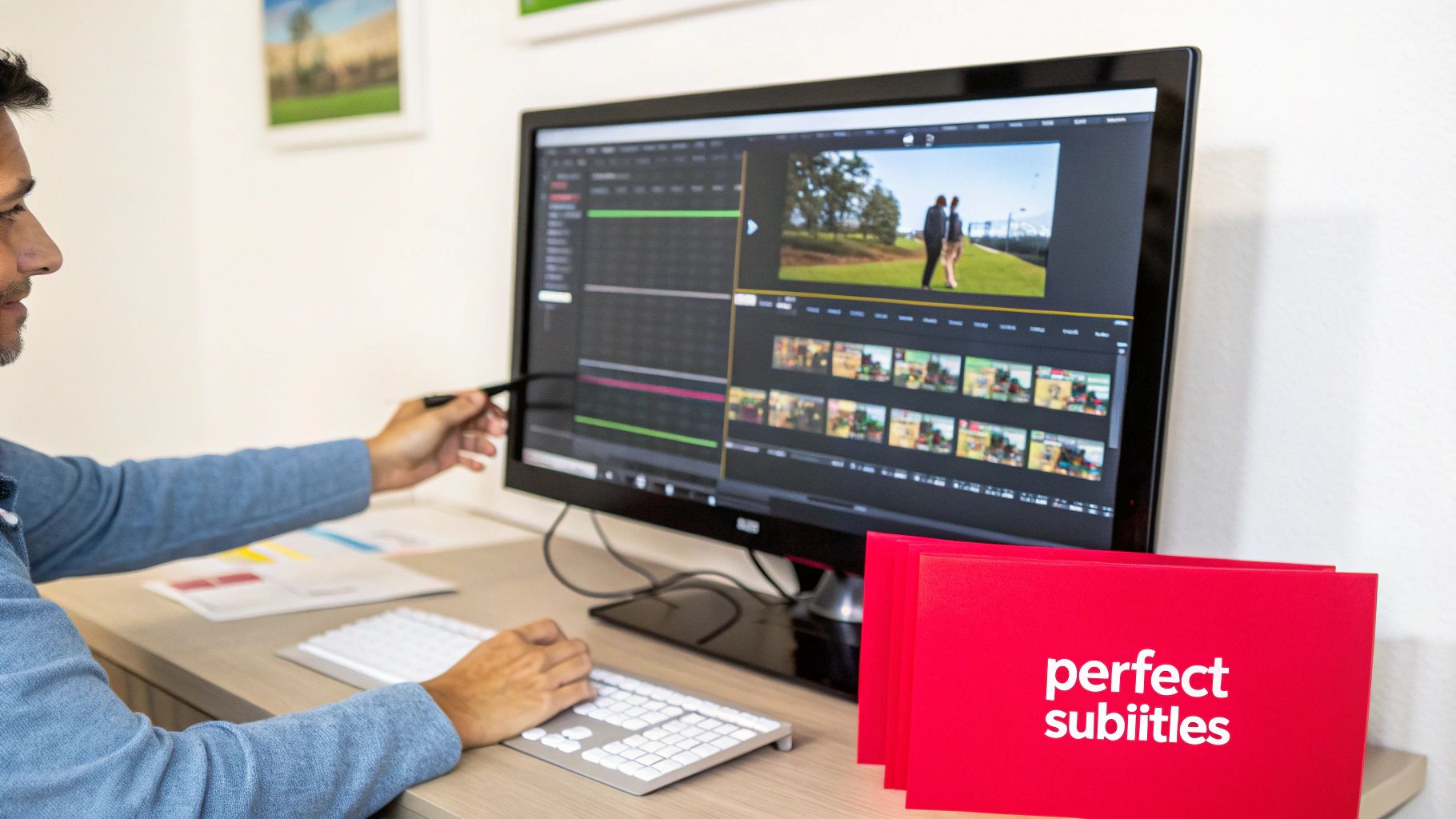
Now comes the really satisfying part: turning your polished English text into perfectly synced subtitles. This is where your careful editing meets the original video, making your content accessible to a wider audience. The secret weapon here is the original timestamped transcript you started with.
Because you kept those timestamps from the initial Romanian transcription, you don't have to go through the headache of timing each line by hand. A tool like YoutubeToText.ai is built for this. It lets you simply drop your new, edited English text back into the original timed structure. Just like that, your subtitles are perfectly aligned with the audio cues in the video.
Choosing Your Subtitle Format
With your English text locked in place, the next step is exporting it in a file that video players can actually read. You’ll generally run into two main formats: SRT and VTT. Understanding the difference is key when you translate Romanian into English for video.
- SRT (.srt): Think of SRT as the universal standard. It’s a plain text file that contains the subtitle number, the start and end times, and the text itself. It’s simple, reliable, and works just about everywhere—Youtube, Vimeo, you name it.
- VTT (.vtt): This is a more modern version of SRT. It does everything SRT does but also lets you add extra styling, like changing the text colour or position on the screen. It's a great choice if you're using a web video player that supports those extra customisation features.
For most projects, you can't go wrong with SRT. Its universal compatibility means you won't have to worry about your subtitles failing to load. This part of the workflow is pretty common regardless of the language; we touch on similar principles in our guide on how to translate from Korean to English.
Best Practices for Readability
Getting the text and timing right is only half the battle. How the subtitles actually look on screen makes a huge difference to the viewer. If they’re clunky or hard to read, they can ruin the whole experience and defeat the purpose of making your content accessible.
The best subtitles are the ones you barely notice. They should feel so natural that the viewer absorbs the information without even realising they're reading, letting them focus on your content.
To pull this off, stick to a few simple rules. Never use more than two lines of text at a time, and try to keep each line under 42 characters. This keeps the screen clean and gives people enough time to read without pausing. It’s also a good idea to break sentences at natural pauses in speech, not just when you run out of space. These small details are what separate amateur subtitles from a truly professional result.
Frequently Asked Questions
When you're trying to translate Romanian into English, a few questions always seem to pop up, especially if you're aiming for a professional finish. Let's tackle some of the most common ones I hear, which should help you solve common problems and smooth out your workflow.
These are the things people often wonder about, from getting the first transcript right to dealing with tricky regional dialects.
What's the Best Way to Translate a Romanian Video?
Honestly, the most reliable method is a mix of smart tech and a human touch. I always start by getting a super accurate Romanian transcript from the video. Using a specialised tool for this is non-negotiable; it gives you a clean, solid foundation and saves a massive amount of time.
Once you have that text, run it through a quality machine translation service for a first pass at the English version. But—and this is the important part—always have a native or fluent speaker of both languages give it a final polish. That final review is where the magic happens, catching all the nuance, idioms, and cultural quirks that automated tools just can't handle.
Can I Just Use Google Translate for Subtitles?
You can, but I really wouldn't recommend it for anything you want to look professional. Throwing raw audio at a generic tool like Google Translate is a recipe for errors. It often mishears words, gets confused by different speakers, and completely fumbles dialects.
My advice? Always start with a proper transcript made by a tool built for video. It cuts down on so many potential mistakes and makes the final subtitles feel far more polished and natural to read. This improves accessibility and the overall viewer experience.
How Should I Handle Romanian Dialects?
Dealing with dialects or strong regional accents always starts with a top-notch transcription tool. A good AI can usually keep up with different accents, but you’ll still need to give that initial Romanian transcript a manual check. Pay close attention to any unique slang or local phrases.
When you get to the translation stage, a human editor is absolutely essential. Machine translation engines are often clueless about regional vocabulary, which can lead to some very strange or just plain wrong translations. An editor who actually knows the specific dialect can make sure those culturally rich terms are translated in a way that keeps the original flavour intact. It’s the only way to ensure your message lands properly with an English-speaking audience.
Ready to get accurate, natural-sounding English translations from your Romanian videos? The first step is a flawless transcript. Give YoutubeToText a try—get your free transcript and see how simple it can be to take your content global. Visit us at https://youtubetotext.ai.