Discover a modern workflow to translate Czech in English for your videos. Learn how to transcribe, translate, and subtitle content for a global audience.
A Content Creator's Guide to Translate Czech in English
When you need to translate Czech into English for your videos, the best results come from a smart blend of technology and human expertise. This approach gives you the speed of AI-powered tools for transcription and translation, solving the productivity problem of slow manual work. At the same time, it uses human review to ensure the accuracy and cultural sensitivity needed to make your content accessible and impactful for a new audience. It's about moving past clunky, word-for-word software to produce translations that feel natural and solve the real problem of connecting with a global audience.
A Modern Workflow for Czech Video Translation
Making your Czech content resonate with a global audience requires a thoughtful, efficient process. Relying on purely manual translation is slow, expensive, and often misses the subtle nuances of the original dialogue. This guide solves that problem by outlining a workflow that's both fast and dependable, ensuring your core message and tone land perfectly with English-speaking viewers, making your content more accessible and repurposed for new markets.
This entire process boils down to four key stages:
- Transcription: The first step is to get all the spoken Czech dialogue down in writing. An AI tool can solve this quickly, creating a clean and accurate text version that's the foundation for everything else.
- Translation: Next, you'll use a robust AI tool to generate the initial English translation from that Czech transcript, boosting your productivity significantly.
- Editing: This is where the human touch comes in. A reviewer solves the problem of cultural mistranslation by going through the AI draft to fix awkward phrasing, correct idioms, and smooth out cultural references.
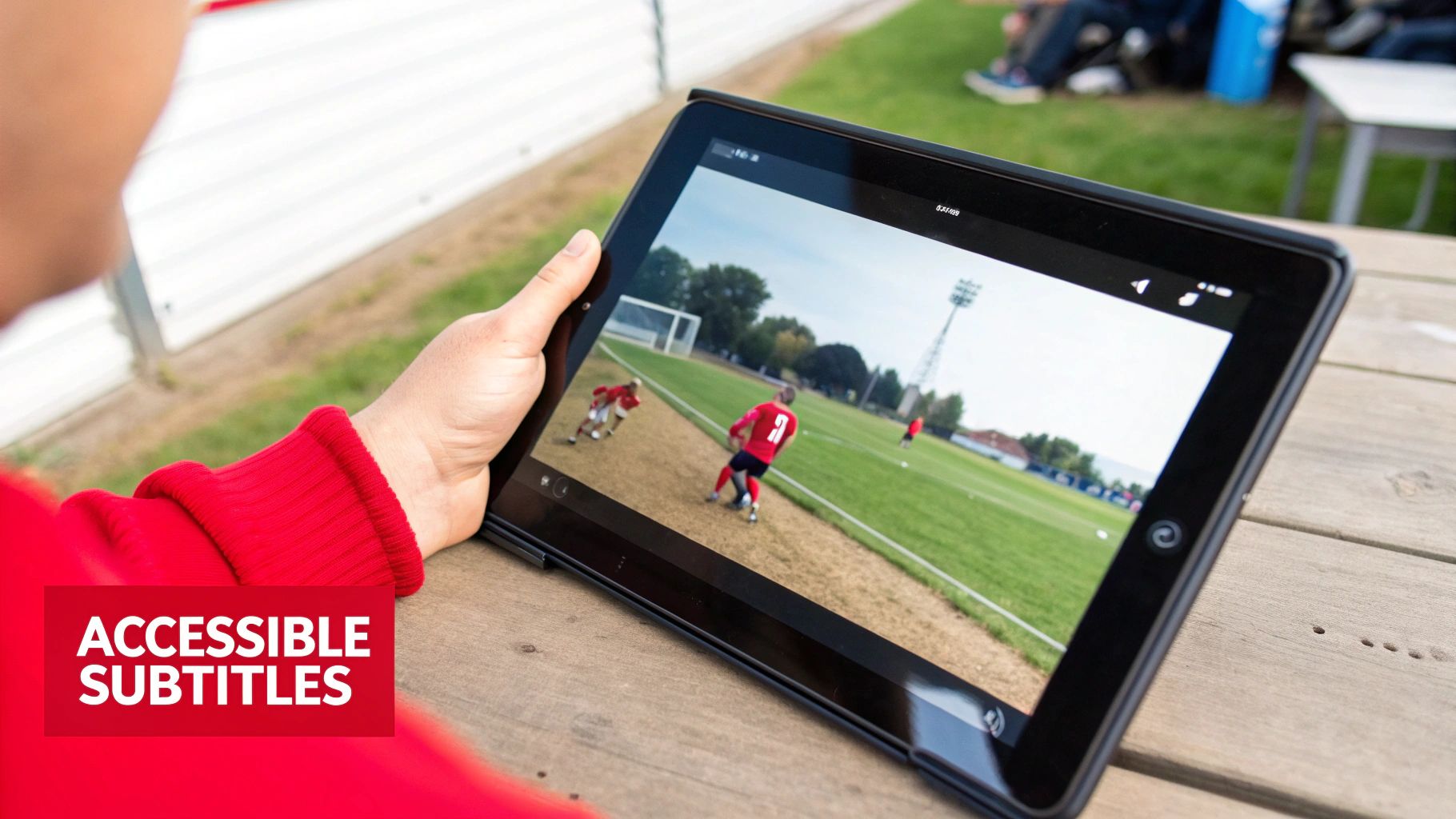
- Subtitling: Finally, you’ll format the polished text into standard SRT or VTT subtitle files. This solves the accessibility problem, making your video understandable to viewers who are deaf, hard of hearing, or watching on mute.
Following a structured approach like this ensures nothing important gets lost along the way. For anyone working frequently with Czech content, a tool like the Polychat App Cesky can be a fantastic addition to this workflow, combining the best of technology's speed with the crucial oversight of a human expert.
The secret to great translation isn't just about finding equivalent words. It's about faithfully transferring meaning, emotion, and context from one language to another. A hybrid AI-human model is the most effective way to strike that perfect balance, solving the core challenge of cross-cultural communication.
To give you a clearer picture, here's a quick summary of the process.
Czech to English Video Translation at a Glance
This table breaks down the four core stages, highlighting what you need to do and what problem you're solving at each step.
| Stage | Primary Action | Key Goal |
|---|---|---|
| Transcription | Convert spoken Czech audio into written text. | Create a precise, verbatim script of the original dialogue. |
| Translation | Use an AI tool to translate the Czech text into English. | Generate a fast, solid first draft of the English translation. |
| Editing | Have a human reviewer refine the AI-generated text. | Ensure accuracy, correct cultural nuances, and perfect the tone. |
| Subtitling | Format the final text into SRT or VTT files with timestamps. | Produce accessible, perfectly synced subtitles for viewers. |
This systematic flow makes the entire task manageable and ensures a high-quality outcome every time.
This infographic lays out the streamlined, four-step journey for your video content.
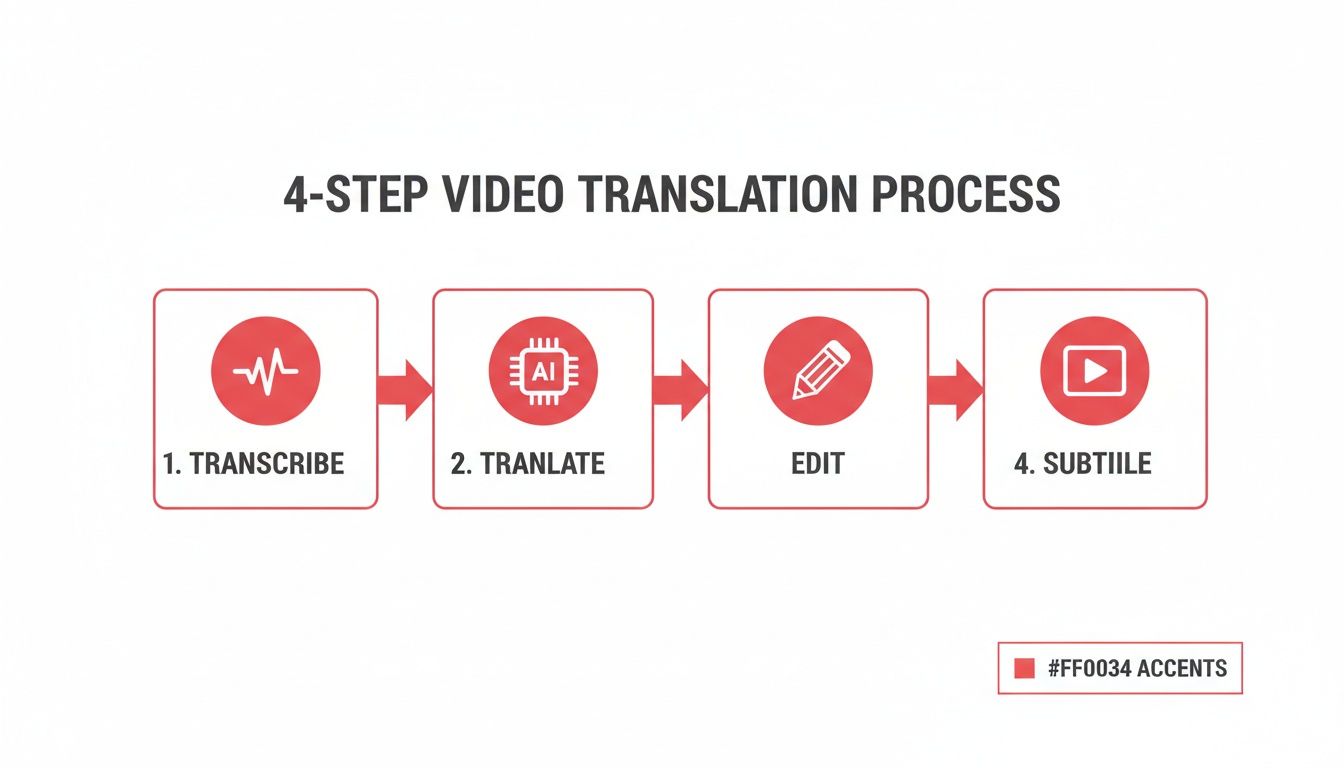
As you can see, each stage logically builds on the one before it, taking you from raw audio to polished, publish-ready subtitles. By adopting this system, you solve the productivity challenge of manual translation and open up your content to a much broader and more engaged audience. In the next sections, we'll dive deeper into each of these stages with practical tips you can use right away.
It all starts with a solid transcript. Before you can even think about translation, you need an accurate, written version of all the spoken Czech in your video. This is your foundation. Getting this step right from the outset saves a world of pain down the line and ensures your final English version truly reflects the original content.
Let's be honest, transcribing a video by hand is a gruelling task. Thankfully, AI tools can do the heavy lifting in minutes, turning what used to be hours of painstaking work into a quick and simple job. These tools produce a clean, time-stamped file that serves as the perfect starting point when you need to translate Czech in English, solving a major productivity bottleneck.
Why Dialects and Speaker Labels Are a Big Deal
Czech isn't a single, uniform language; it's full of regional flavours. This is where a good transcription service really shines. The best ones are trained on massive, diverse datasets, which means they can pick up on and accurately capture these subtle differences, solving the problem of misinterpreting regional speech.
Think about it: over 10 million people speak Czech. The common Bohemian dialect sounds quite different from the variations you'd hear in Moravia. A high-quality, editable transcript that understands these regional nuances will always beat a manual attempt. For instance, one analysis pointed out Brno's high English Proficiency Index (EPI) of 612, a world away from Hradec Králové's 550. This signals just how different communication styles can be. You can discover more about Czech regional language variations in this study.
Another game-changing feature that solves a common editing problem is speaker identification. If you have multiple people in your video, like an interview or a panel, the service needs to be able to tell who is speaking.
This gives you a script that’s incredibly easy to work with:
- Speaker 1 (00:01:15): Ahoj a vítejte u dnešního podcastu.
- Speaker 2 (00:01:17): Děkuji za pozvání, jsem rád, že tu mohu být.
This simple labelling makes everything clearer and is absolutely essential for creating subtitles that correctly assign dialogue to the right person, making your content more accessible.
A clean, well-structured transcript with correct speaker labels and timestamps is more than just text; it's the blueprint for a successful translation. It solves the problem of guessing who said what, which is a common headache in manual transcription.
Giving Your Audio the Best Chance
As good as AI transcription is, it's not magic. The old saying "garbage in, garbage out" is especially true here. To solve the problem of inaccurate transcripts, you need to feed the AI the cleanest audio you possibly can.
Here are a few practical tips I've learned for improving audio quality:
- Use a Decent Microphone: An external microphone will always capture clearer sound than the one built into your camera. It's a small investment with a huge payoff for accuracy.
- Minimise Background Noise: Find a quiet space. Record away from busy streets, humming fridges, or air conditioning units. This helps the AI focus on the speech.
- Speak Clearly: Remind anyone on camera to articulate properly and not to mumble. The clearer the speech, the more accurate the transcript.
- Avoid Overlapping Speech: When people talk over each other, it’s a nightmare for both humans and AI to untangle. Encouraging speakers to let one person finish before the next one starts improves transcription quality immensely.
By putting a little effort into capturing clear audio upfront, you’re setting yourself up for a much more accurate transcription. This initial work really does pay for itself by cutting down on the time you'll spend making manual corrections later. You can also learn more about converting audio to text in our guide, which has even more tips for solving common audio problems.
Using AI for a Powerful First Draft Translation
Once you have an accurate Czech transcript ready, it's time to solve the next productivity challenge: the first pass of the English translation. This is the perfect job for an AI translation tool. Think of it as an incredibly fast and capable assistant that can process your entire script in moments, giving you a solid foundation to build on.
Modern machine translation has come a long way from the clunky, word-for-word swapping of the past. Today’s systems are smart enough to analyse sentence structure, grammar, and context, producing drafts that are surprisingly coherent. For anyone needing to translate Czech in English on a deadline, this technology is a huge help, turning what used to be a laborious task into a job that takes just a few minutes.
Speed Without Sacrificing Quality
The biggest problem AI solves here is, without a doubt, speed. Manually translating a 30-minute video script could easily eat up a whole afternoon. An AI tool can spit out a complete English draft in under a minute, and it's often 80-90% of the way to being perfect.
This isn't just about speed, though; the quality is genuinely impressive. In the industry, we often measure this using a BLEU (Bilingual Evaluation Understudy) score, which compares the AI's output to a professional human translation.
Research from Charles University on Czech-to-English machine translation, for example, has shown systems achieving BLEU scores as high as 83. That number signifies a very strong correlation with what a human expert would produce. This level of dependability solves the problem of unreliable, low-quality machine translations.
I like to think of AI as a junior translator. It does all the heavy lifting with incredible speed, delivering a draft that’s grammatically sound and makes sense. My job is to come in as the senior editor and polish the nuances that only a human can truly grasp, solving the 'last mile' problem of translation.
Choosing the Right Translation Tool
Of course, not all AI translation platforms are built the same. When you're picking a tool to fit into your workflow, you need to look for features that actually help with content creation. For those who prefer a dedicated solution, an application like the Lunabloom AI app is designed to handle these kinds of tasks quite well.
Here are a few things I always look for to solve common workflow issues:
- Smooth Integration: Can the tool easily import my transcript? A seamless connection between your transcription and translation steps saves a ton of time and avoids silly copy-paste mistakes.
- Contextual Smarts: Look for platforms that talk about handling context and idioms. This is a dead giveaway that they’re designed for more than just simple sentences.
- Solid Security: Always check the privacy policy. If your content is sensitive or pre-release, you need to know your data is safe.
The goal here isn't to get a perfect final product straight from the machine. It's about getting a strong first draft that you can refine. This AI-generated text is a crucial, time-saving step that makes the whole process more manageable and affordable, freeing you up to focus on what really matters: solving the problem of how to make your message connect with your new English-speaking audience.
Refining for Nuance and Cultural Context
So, you’ve got your initial AI translation. It's a fantastic starting point, but now comes the part where the real magic happens. This is where you solve the critical problem of cultural relevance, transforming a technically correct script into something that truly connects with an English-speaking audience.
A direct, literal translation often misses the heart of the message, leaving you with words that are accurate but feel a bit lifeless. It’s human insight that bridges this gap, ensuring your brand's unique voice comes through loud and clear. This is less about swapping words and more about translating the feeling behind them.
Beyond Literal Translation
Let’s be honest, many Czech idioms and common sayings just don’t have a clean, one-to-one English equivalent. If you translate them word for word, you’ll end up with something that’s confusing at best and comical at worst—a sure-fire way to distract your audience.
Here are a couple of classic examples where a literal translation creates a problem:
Czech Phrase: “Mít máslo na hlavě”
Literal English: “To have butter on one’s head.”
Actual Meaning: To be guilty of something. The much more natural English equivalent is “to have skeletons in your closet.”
Czech Phrase: “Chodit kolem horké kaše”
Literal English: “To walk around hot porridge.”
Actual Meaning: To avoid getting to the point. An English speaker would immediately recognise this as “to beat around the bush.”
Catching and adjusting these phrases is crucial. You're not looking for the closest words; you're hunting for the equivalent idea that clicks instantly for your new audience. This is what solves the problem of sounding foreign and unprofessional.
Maintaining Your Brand’s Voice and Tone
Your tone is a massive part of what makes your brand your brand. Are you witty and informal? Or are you more serious and authoritative? An AI translation can sometimes flatten these personality traits, giving you a script that’s correct but generic.
Think of post-editing as your final quality check. It’s your chance to solve the problem of a generic, soulless translation and ensure the clever wordplay or empathetic tone from your original Czech content has made the journey into English intact. Skip this, and you risk losing the very spark that makes your content special.
The need for this kind of culturally sharp translation is only growing. Take the Netherlands' translation industry, where firms often manage Czech-to-English projects. In 2021, this specific language pair accounted for 0.5% of their total volume. With top Dutch sites showing an 81.2% Czech localisation rate, it's clear that repurposing content between these languages is a significant market. For anyone using a tool like YoutubeToText, this simply underscores how vital it is to turn Czech videos into fluent, natural-sounding English.
This process of refining the tone isn't unique to Czech, of course. You might find some interesting parallels in our guide on how to translate from Korean to English.
By investing the time to post-edit, you create a final product that's not just a translation, but a true adaptation—one that honours the original while speaking directly to your new viewers.
You’ve done the hard work of translating and editing, and now your English script is ready for the spotlight. The final step is turning that text into professional, accessible subtitles. This isn't just a technical task; it's about making your content welcoming to a much wider audience—from viewers who are deaf or hard of hearing to those who just prefer watching videos on mute. This solves the problem of excluding a significant portion of your potential audience.
Thankfully, the days of manually syncing text to video are long gone. Modern tools can take your polished English transcript and automatically generate a perfectly timed subtitle file, like an SRT or VTT. The software analyses the audio from your original Czech video and matches each line of your script to the precise moment it’s spoken.
Making Subtitles Readable
Getting the timing right is only half the battle. If your subtitles are hard to read, you risk losing your audience. Cluttering the screen with too much text or flashing lines on and off too quickly will frustrate viewers and undermine your message.
To solve the problem of unreadable subtitles, stick to a few professional standards:
- Line Length: Aim for no more than 42 characters per line. This keeps the text neat and prevents it from covering up important visuals in your video.
- Two-Line Rule: Never display more than two lines of text at once. Anything more becomes a block of text that’s tough to read while trying to watch the action.
- Reading Pace: A good benchmark is to keep text on screen for at least one second for every three words. This gives people enough time to read and process the information comfortably.
The best subtitles are the ones you barely notice. They should feel like a seamless part of the viewing experience, solving the problem of viewer distraction and helping the audience absorb the content without pulling their focus away from the video itself.
Following these simple guidelines makes a world of difference. When you translate Czech content for English-speaking viewers, clarity is everything. Clean, well-paced subtitles ensure your message lands perfectly without causing any frustration.
Turning Your Text into a Subtitle File
The two most common subtitle formats you'll encounter are SRT (SubRip Text) and VTT (WebVTT). At their core, both are just simple text files that pair your script with start and end timestamps. For any content creator, having a tool that handles this conversion instantly is a massive time-saver.
An entry in an SRT file, for example, is structured very simply:
1
00:00:15,345 --> 00:00:18,123
Welcome to today's podcast.
2
00:00:18,567 --> 00:00:21,890
Thank you for having me,
it's great to be here.
This universal format works flawlessly on platforms like Youtube and Vimeo, so you can just upload the file and you're good to go. If you want to get into the nuts and bolts of it, we have a handy guide on how to convert a plain TXT file into a perfectly formatted SRT file. This final step is what ensures all your hard work pays off, making your content accessible to everyone.
Common Questions About Czech to English Translation
Diving into Czech-to-English video translation often brings up a few practical questions. Getting the details straight from the start helps you pick the right approach and set realistic expectations for your project. Let's walk through some of the things people ask most often.
How Accurate Is AI for Translating Czech to English?
This is the big one. The short answer is: AI translation is incredibly accurate for getting the core grammar and common vocabulary right. It's a fantastic tool for generating a solid first draft, saving you a huge amount of time.
Where you'll see its limits is with the finer points of language. AI can miss the mark on subtle idioms, specific cultural humour, or the kind of context a native speaker just gets. That’s why it’s best to think of AI as an invaluable assistant, not the final word.
Think of it this way: AI gets you about 90% of the way there with a near-perfect draft. That final 10% is where a human editor comes in to polish the text, making sure the tone is spot-on and it reads naturally for an English-speaking audience.
Can This Process Handle Different Czech Dialects?
Yes, it can. Modern AI transcription tools have been fed massive amounts of audio data, which includes a wide range of regional dialects from Bohemia, Moravia, and Silesia.
Of course, you'll always get the most flawless transcript from standard Czech (spisovná čeština). But today’s tech is surprisingly good at picking up on common regional differences. If your source video has a particularly thick or less-common dialect, it's a good idea to give the initial Czech transcript a quick once-over. This lets you catch any small mistakes before you even get to the translation part.
Getting the source text right is the foundation for a high-quality English translation, so that small check can make a big difference.
How Long Does It Take to Translate a One-Hour Video?
Using a workflow like this dramatically cuts down the time. For a typical 60-minute video, here’s what you can realistically expect:
- AI Transcription: This part is lightning-fast. Generating a full, time-stamped transcript usually takes just 5 to 10 minutes.
- AI Translation: Turning that Czech transcript into English is even quicker, often done in 1 to 2 minutes.
- Human Editing: Here’s where the timing can vary. Depending on how technical or creative the content is, a careful review and polish by a human can take anywhere from 1 to 3 hours.
When you compare that to a traditional, fully manual translation—which could easily eat up over eight hours for the same video—the efficiency is clear. You can get your content in front of a new audience in a fraction of the time.
Ready to get your Czech content translated quickly and accurately? YoutubeToText simplifies the whole process. Get precise transcriptions, instant translations, and one-click SRT subtitle downloads to make your videos accessible worldwide. Start your first project today at https://youtubetotext.ai.