Learn translation in thai with expert tips on video transcription, accurate subtitles, and cultural localization for authentic viewer engagement.
Translation in Thai: A Practical Guide to Video Localization & Subtitles
Translating your videos into Thai isn't just about swapping out words; it's about solving a critical problem for creators and businesses: how to connect with a massive, digitally-savvy audience of over 60 million people. This guide will show you how to move beyond simple translation to truly localize your content, making it feel native for Thai viewers. For anyone serious about growing their presence in Southeast Asia, this isn't just an option—it's an essential strategy for growth.
Why Thai Translation Is Your Next Big Win
If you're not considering the Thai-speaking market, you're leaving a huge and highly engaged audience on the table. It's not just about the sheer number of people; it's about connecting with a vibrant online community that's actively looking for new things to watch. Many creators and businesses see the potential in Thailand but get stopped by the language barrier, a problem that technology can now help solve.
The good news? The tools we have today make bridging that gap easier than ever. Getting your videos translated into Thai isn't just some technical task anymore. It's a strategic decision that can dramatically boost how far your content travels and how deeply it connects, turning a language barrier into a growth opportunity.
Tapping into a Booming Digital Market
Thailand's online scene is absolutely buzzing. For creators, this means there's a direct path to new viewers who are genuinely hungry for great content. The language has always been the main hurdle, but getting past it is now well within reach.
Here's how this solves real problems for your content strategy:
- Massive Engagement: Thai viewers are famous for their high engagement rates on platforms like Youtube and Facebook. They don't just watch; they comment, like, and share. Translating your content helps you tap into this active community.
- A Mobile-First Audience: Most people in Thailand watch videos on their phones. This makes subtitled content a perfect solution for reaching them how they consume media on the go.
- E-commerce Potential: If you're selling something, translating your product videos can have a direct impact on your sales in one of Southeast Asia’s biggest e-commerce hubs, solving the problem of international market entry.
The first step is always getting a clean transcript of your video. A tool like YoutubeToText.ai simplifies this initial, crucial step.
As you can see, you just pop in a Youtube link, and it pulls out all the spoken text for you. That transcript becomes the foundation for everything that follows, from subtitles to the final translation, streamlining your entire workflow.
The Power of Accessible Tech
Modern cloud-based tools have completely changed the game. Machine translation, in particular, has become a go-to for creators needing to work quickly. In fact, since 2020, these platforms have boosted efficiency by over 40% in key Thai sectors like tourism and e-commerce. This is crucial when you're trying to serve Thailand's 15 million Youtube users, who rack up a staggering 10 billion views every month—mostly in Thai. If you want to dive deeper, you can learn more about the Asia-Pacific machine translation market on Market Data Forecast.
When you decide to translate your content into Thai, you're doing more than just adding another language option. You're making a calculated move to connect with millions of potential fans and customers in a market that is actively searching for fresh content.
Getting Your Thai Transcript Right From the Start
Before you can solve the problem of reaching a Thai audience, you must first solve a more immediate one: getting a rock-solid transcript. This text version of your video is the absolute foundation for everything that follows, whether it's subtitles or a full voice-over. If your source transcript is weak, even the most talented translator will be fighting a losing battle, and your message will get lost.
Let's be honest, manually transcribing audio is a soul-crushing task. It's a tedious cycle of play, pause, rewind, and type that kills productivity. For anyone juggling multiple projects, it’s just not a good use of time. Plus, it's incredibly easy to make mistakes, especially when people talk fast or over each other.
Why a Great Transcript Is a Non-Negotiable First Step
Here's something you have to understand about the Thai language: tone is everything. A tiny shift in pitch can completely change a word's meaning. Take the syllable mai—depending on the tone, it can mean "no," "new," "wood," or "burn." If your transcription tool can't pick up on that nuance, you'll end up with a script that’s complete nonsense.
That's why a high-quality transcript is the essential first move. It locks in your core message. It correctly identifies all the proper nouns, technical jargon, and slang that a translator, working without the original audio, could easily get wrong. Nail this part first, and you'll save yourself a mountain of headaches and expensive revisions down the line.
The journey to reach the Thai market often looks something like this:
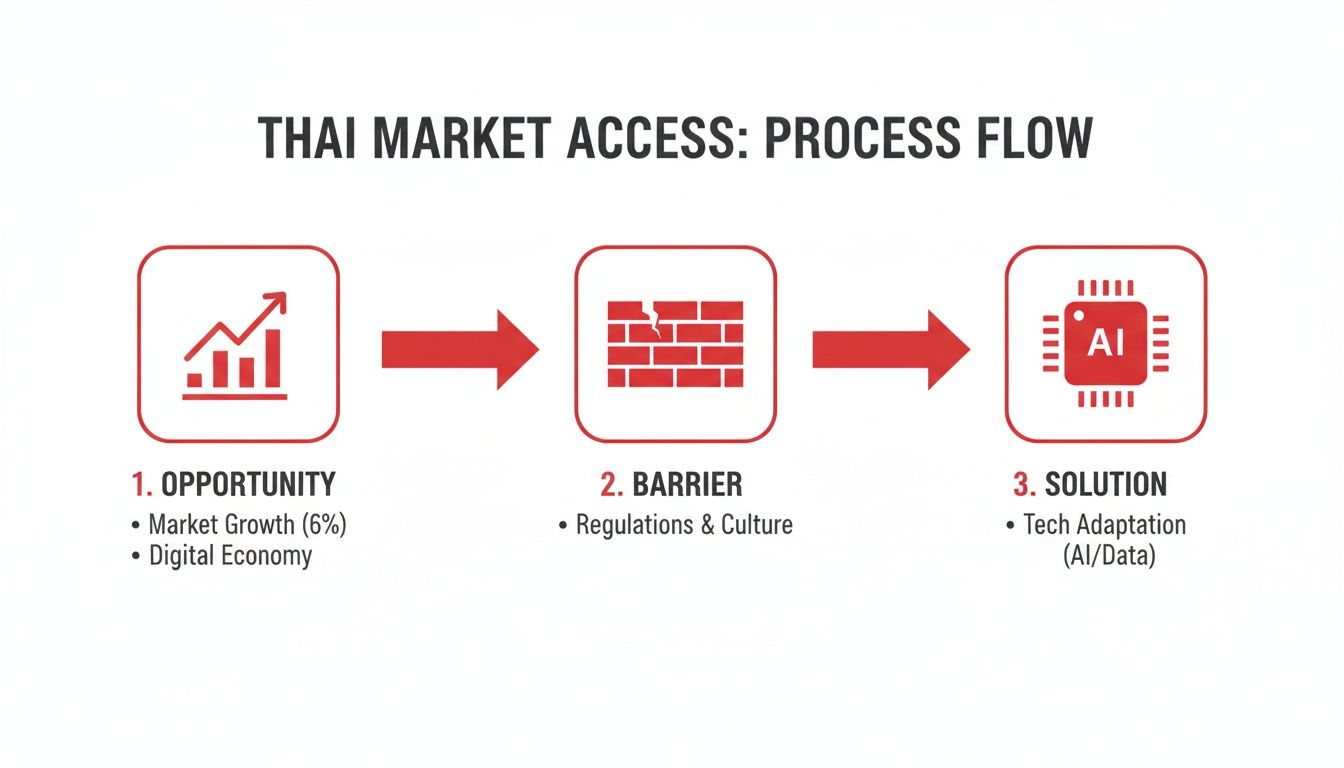
As you can see, technology is what bridges the gap, turning the language barrier from a roadblock into a simple step in the process.
From a Video Link to Text in Minutes
Thankfully, we no longer have to do this the hard way. Modern tools like YoutubeToText.ai have completely changed the game, solving the productivity problem by turning hours of work into a quick, simple task. All you have to do is drop in a Youtube video link, and the AI takes care of the rest.
In just a few moments, you get a full, time-stamped transcript. What’s amazing is how well these tools handle different accents and speaking speeds. The draft you get back is often 85-95% accurate, which is a huge head start. If you want to dive deeper into the technical side, we have a whole guide on how to automatically convert audio to text.
The real win with AI transcription isn't about getting a perfect, hands-off result. It's about solving the productivity drain by eliminating 90% of grunt work so you can focus your energy on the final, crucial polish.
This flips the script entirely. Instead of wasting time on tedious typing, you can jump straight into the high-value work of editing and refining.
The Human Touch: Cleaning Up and Polishing
Once the AI has done its part, it's your turn. This final review is quick, but it's what takes the transcript from "good enough" to perfect, making it ready for a professional translator.
Here's a practical checklist for your clean-up pass:
- Check the Speaker Labels: The AI is smart about telling voices apart, but it can slip up. A quick check to make sure
[Speaker 1]and[Speaker 2]are assigned correctly is crucial for accurate dialogue in the final translation. - Fix Proper Nouns and Jargon: Keep an eye out for names, brands, or niche industry terms. AI has a massive vocabulary, but it can still stumble on unique or technical words.
- Adjust Punctuation for Natural Flow: Automated transcripts can sometimes create clunky, run-on sentences. Adding full stops and commas not only improves readability but also gives the translator vital clues about pauses and inflection.
- Listen for What the AI Missed: The final step is to read along while listening to the audio one last time. This is where you'll catch sarcasm, a question hidden in a statement, or a subtle cultural reference that’s key to the meaning.
By combining the speed of AI with your own expert oversight, you create the perfect foundation. This clean, accurate transcript is your ticket to a high-quality, culturally-aware translation that genuinely connects with your new Thai audience.
Choosing Your Translation Method
With your clean transcript ready, you've hit a major decision point. Should you go with the speed of machine translation or the deep understanding of a professional human translator?
Honestly, there's no single "best" answer here. It’s all about solving your specific project's needs by picking the right approach based on your budget, timeline, and goals. Getting this right is what makes the difference between a clunky translation and one that genuinely clicks with your Thai audience.
When Machine Translation Is Your Best Bet
Let's be clear: automated translation tools are incredibly fast and have come a long way. For many creators, they’re a lifesaver, delivering results almost instantly and solving the problem of tight budgets and deadlines.
Think of machine translation as the go-to option when speed is everything and a general understanding is all you really need.
- Quick Internal Research: Need to figure out what a Thai competitor is saying in their latest video? A machine translation will give you the gist in minutes.
- Low-Stakes Content: For things like user comments or internal training videos, where a bit of awkward phrasing won’t hurt, an automated tool is perfectly fine.
- Creating a First Draft: This is a huge time-saver. Let an AI tool do the initial heavy lifting to create a rough translation. A human can then swoop in to refine and perfect it.
As you look into different tools, you’ll even find specialised services for specific content types, like an English to Thai book translator. This can be a great asset if you’re adapting longer written works into video scripts.
The Power of a Professional Human Translator
But sometimes, an algorithm just won't cut it. When your brand's reputation is on the line, or you're trying to educate, entertain, or build a real connection, you absolutely need the cultural know-how of a professional human translator to solve the problem of cultural disconnect.
A person doesn't just translate words; they translate meaning. This is mission-critical for a tonal language like Thai, where things like politeness and social context are woven directly into the language itself.
Here are a few situations where you should always invest in a human expert:
- Marketing and Advertising: Your slogan or call-to-action needs to land perfectly. A human translator makes sure your brilliant tagline doesn’t accidentally become an embarrassing cultural blunder in Thai.
- Technical or Educational Videos: When you're explaining something complex, like in a software tutorial or a medical video, accuracy is non-negotiable. A subject-matter expert ensures every detail is conveyed correctly.
- Storytelling and Humour: Jokes, sarcasm, and emotional stories are notoriously hard to translate. They rely on cultural cues that AI often misses. A human can adapt these moments so they feel authentic, not forced.
Even with all the progress, AI still stumbles. Industry benchmarks show that AI often only achieves 70-75% accuracy with Thai idioms and other nuanced phrases. This gap is precisely where human expertise becomes so valuable.
Machine Translation vs Human Translation for Thai Content
So, how do you decide? This table breaks down the key differences to help you choose the right path for your project.
| Factor | Machine Translation (e.g., Google Translate) | Professional Human Translation | Best For |
|---|---|---|---|
| Speed | Nearly instant. | Hours to days, depending on length. | Machine: Solving the problem of rapid turnaround for drafts and internal content. |
| Cost | Free or very low-cost. | Significant investment per word/minute. | Machine: Projects with a tight or non-existent budget. |
| Accuracy | Good for literal meaning, but struggles with nuance, idioms, and tone. | High accuracy, capturing cultural context and intended meaning. | Human: Marketing, legal, technical, and high-value content. |
| Cultural Context | Lacks awareness of cultural norms, politeness levels, and local references. | Deep understanding of Thai culture ensures the message is appropriate and resonant. | Human: Any public-facing content where connection matters. |
| Tone & Style | Tends to be flat and literal. Can sound robotic. | Can adapt the tone to match your brand voice—be it professional, funny, or empathetic. | Human: Creative storytelling and brand-building videos. |
Ultimately, choosing between machine and human translation isn't an either/or dilemma. The smartest workflow often blends the two.
Use AI for its incredible speed to get a solid first draft, then bring in a human expert to add the essential layer of cultural nuance, polish, and accuracy. This hybrid approach gives you the best of both worlds, solving for both speed and quality.
Take a good look at what your video needs to accomplish. By understanding where machines excel and where a human touch is irreplaceable, you can build a process that is both efficient and delivers a final product that truly speaks to your Thai audience.
Making Your Content Truly Thai: The Art of Localisation
If you want to build a real connection with a Thai audience, a simple word-for-word translation just won't cut it. The real magic happens when you move from translation to localisation. This is about more than just swapping languages; it's about weaving your content into the cultural fabric of Thailand so it feels familiar, respectful, and genuinely made for them. This solves the core problem of making foreign content feel local.
When you get this right, your content doesn't just get understood—it resonates. It shows you've put in the effort to understand the culture, and that’s something that builds trust and a loyal following.
Getting the Cultural and Language Details Right
In Thailand, language and culture are deeply connected, especially when it comes to politeness and social hierarchy. A literal, machine-driven translation almost always misses these crucial nuances, which can make your content feel awkward or, even worse, disrespectful. Nailing these details is the cornerstone of effective translation in thai.
A perfect example is the use of polite particles. Male speakers add khráp (ครับ) and female speakers add khâ (ค่ะ) to the end of sentences to sound courteous. A machine translation often drops these, making the speaker sound blunt or even rude to a Thai ear.
The goal of localisation isn't just for your audience to understand your words, but to feel your message. It’s about adapting your content’s tone, style, and cultural references to fit seamlessly into their world.
This becomes even more critical with formal language. For instance, if your content ever mentions the Thai royal family, you have to use a special royal vocabulary called Rachasap (ราชาศัพท์). An automated tool will absolutely get this wrong, leading to a major cultural blunder. This is precisely where a native Thai speaker's expertise is non-negotiable.
Adapting Humour and On-Screen Elements
Humour is notoriously difficult to translate. A joke that kills in the West can easily fall flat—or be outright offensive—in Thailand. Things like sarcasm, irony, and pop culture references just don't travel well because they rely on shared cultural knowledge.
Here, the goal isn't direct translation but transcreation. You're not translating the words; you're recreating the feeling of the joke with a culturally relevant equivalent. A reference to a famous Western actor might be swapped for a popular Thai celebrity to get the same laugh. While AI is getting smarter, it can still miss the mark on up to 25% of Thai humour or royal references. The global translation services market is growing, but this human touch remains vital.
This same principle applies to everything you see on screen. All your text, graphics, and data need to be localised. This checklist helps you solve common localization oversights:
- Text in images: Banners, titles, and callouts in your video need to be in Thai.
- Formatting: Dates should be in Day/Month/Year format, currency needs the Thai Baht (฿) symbol, and measurements must be converted to the metric system.
- Visuals: Double-check that your images, icons, and even colour choices are culturally appropriate and don't carry any unintended negative meanings in Thailand.
From Literal Words to Cultural Connection
Let's break it down with a real-world example. Imagine an English slogan: "Our software works around the clock to give you peace of mind."
A literal translation might be: "ซอฟต์แวร์ของเราทำงานตลอด 24 ชั่วโมงเพื่อให้คุณสบายใจ" (Our software works 24 hours to make your heart comfortable). It’s technically understandable, but it sounds robotic and clunky.
Now, a properly localised version would sound more like: "ให้ซอฟต์แวร์ของเราดูแลงานแทนคุณ ทุกที่ ทุกเวลา" (Let our software take care of the work for you, anywhere, anytime). See the difference? This version is smoother, more professional, and captures the core benefit in a way that truly connects with a Thai business audience.
By focusing on these details, you shift your content from being a foreign import to something that feels like it was created just for them. To learn more about the mechanics of the process, dive into our guide on how to translate any Youtube video.
Bringing Your Thai Subtitles to Life
With your localised translation ready, it's time to turn that script into a professional, viewer-friendly asset. This is where you create synchronised subtitles that make your video accessible and engaging for your Thai audience. It’s a craft that requires both technical accuracy and an eye for readability, solving the problem of how to present your translated text effectively.
The end goal is a subtitle file, usually in either SRT (SubRip Text) or VTT (WebVTT) format. SRT is the classic, no-fuss format that’s supported everywhere. VTT is a bit more modern and allows for text styling like bold or italics, making it a great choice for web videos. The first step, no matter the format, is getting a clean transcript; learning how to transcribe a video to text accurately is the foundation for everything that follows.
Thankfully, you don't have to build these files from scratch anymore. Tools like YoutubeToText.ai can do the heavy lifting, generating a time-stamped SRT or VTT file right from your transcript in just a few clicks. This gives you a massive head start, solving hours of tedious manual work. If you're curious about the nuts and bolts of how this works, we have a guide on creating an SRT file from TXT.
The Human Touch: Polishing Your Subtitles
Getting an automated subtitle file is just the beginning. The real magic happens in the final polish, where you refine the raw output to create the best possible viewing experience. This is what separates amateur subtitles from a professional final product. Your aim is to make them so seamless that the viewer almost forgets they're even there.
This refinement process really boils down to three key things: readability, timing, and consistency. You need to make sure the text is easy to read at a natural pace, pops up exactly when someone speaks, and follows the same formatting rules throughout the video.
Making Subtitles Easy on the Eyes
Nothing kills the viewing experience faster than a giant wall of text at the bottom of the screen. Viewers are trying to watch the action, not read a novel. To avoid this, you need to break down your translated sentences into small, digestible chunks.
Here are a few essential tips I always follow:
- Keep Lines Short: Stick to a maximum of two lines per subtitle. Any more than that and you're cluttering the screen.
- Watch Your Character Count: I aim for under 42 characters per line. This is a good rule of thumb to ensure the text can be read quickly, even on a phone.
- Break Sentences Logically: Don’t just cut a sentence in half. Find natural pauses—like after a comma or before a conjunction—to make the breaks feel smooth and maintain the original flow.
Nailing the Timing
Perfect timing is what makes subtitles feel invisible. The text has to appear the instant someone starts talking and vanish as soon as they stop. Even a half-second delay feels off and can pull your audience out of the moment.
When you get your generated subtitle file, play the video and watch it like a hawk. Tweak the timestamps for each line until they are perfectly aligned with the audio. Pay extra close attention to fast-paced conversations or scenes with multiple speakers to ensure the right text is always matched to the right person.
A polished subtitle file isn't just a transcript with timestamps; it's a carefully crafted element designed to enhance the viewing experience without getting in the way. The best subtitles are the ones you forget are even there.
This workflow is a game-changer for creators, especially those in fast-moving niches like gaming. For video editors and subtitlers, using a tool like YoutubeToText.ai for Thai gaming streams means one-click SRT downloads can slash production time by 80%. The machine-generated file handles about 80% of the initial work at an 80% lower cost and is 10x faster, freeing you up to focus on that crucial final polish. It’s how you solve the problem of scaling content production efficiently.
Making Your Videos Work Harder: SEO and Accessibility in Thai
Translating your video into high-quality Thai does more than just open the door to a new audience. It's a smart move that solves two more critical problems: boosting your video's discoverability and making it more inclusive. This is where all that effort in translation starts to pay real dividends in views, engagement, and reach.
When you add Thai transcripts and subtitles, you’re essentially handing search engines like Google and Youtube a complete script of your video. Their bots can now read and understand exactly what your content is about, which massively increases its chances of showing up when people search for those topics in Thai. You're no longer just competing on English keywords; you're now visible to millions of Thai speakers looking for what you have to offer.
Getting Found: How to Optimise for Thai Search
To really capitalise on this, you need to get inside the head of your Thai audience. A direct translation of your English keywords probably won't cut it. You need to do a bit of research to find the actual phrases and terms that a native Thai speaker would use. Think about colloquialisms and local search habits.
Once you’ve got a solid list of Thai keywords, strategically place them where they’ll have the most impact:
- Video Title: Make sure your main Thai keyword is right there in the title. It’s the first thing the algorithm (and a potential viewer) sees.
- Video Description: Use the description to elaborate on your video's topic, naturally working in your primary and secondary keywords.
- Video Tags: Mix it up with both broad and specific Thai tags to catch a wider range of search queries.
This tells Youtube’s algorithm in no uncertain terms that your video is a top-tier result for those search terms, helping it climb the rankings.
A Big Win for Accessibility
Beyond the search rankings, adding subtitles is a fundamental step toward making your content more inclusive. You instantly solve the accessibility problem for the deaf and hard-of-hearing community in Thailand—an audience often left out of the conversation. It’s a simple gesture that shows you care and ensures your message is available to everyone.
Good content should be for everyone. Adding Thai subtitles isn't just a technical checkbox; it's about building a more inclusive community around your work and showing respect for your entire audience.
But the benefits don't stop there. Think about how many people watch videos on their commute, in a noisy café, or late at night with the sound off. For this huge group of people, subtitles aren't a bonus feature; they're the only way they can watch. This is how you ensure your video can be watched by anyone, anytime, anywhere, truly maximising its reach.
Still Have Questions About Thai Video Translation?
Even after you've got your process mapped out, a few questions tend to pop up. Let's tackle some of the most common ones I hear from creators so you can get started without a hitch.
A big one is always about the accuracy of AI tools. People want to know if they can really trust them. Here's the deal: for getting the gist of something or creating a rough first draft, they are incredibly helpful and fast. But are they perfect? Not yet. For anything important – think marketing videos, product tutorials, or educational content – you absolutely need a human to look it over. AI can miss the tiny nuances in tone and context that a native speaker catches instantly.
What’s This Going to Cost, and How Long Will It Take?
This is where the classic "it depends" answer comes in, but I can give you some solid guideposts. Your budget and timeline will really steer you towards one of two paths.
- Machine Translation: This is your near-instant, low-cost option. You can get a translation in minutes for next to nothing. It's perfect for internal use or when you just need a quick sense of what's being said.
- Professional Human Translation: This is a proper investment in quality. You could be looking at anything from a few pounds to over £20 per video minute, and it will likely take a few days. For any content that represents your brand, this is the only way to guarantee cultural accuracy and a professional finish.
So, how do you choose? It all comes down to what the video is for.
My advice? Don't think of it as an either/or situation. The smartest workflow I've seen combines both. Use an AI tool to get a transcript and a first-pass translation done in minutes. Then, hand that off to a professional Thai translator for polishing. This hybrid approach solves the problem of balancing speed, cost, and quality for a proper translation in thai.
When you remember that Thailand has a 70% smartphone penetration rate and over 50 million people on Youtube every single day, getting the translation right isn't just a small detail—it's a massive growth opportunity. To get a broader view, check out the latest data on the global translation services market on Mordor Intelligence.
Ready to get started? With a tool like YoutubeToText, you can pull an accurate transcript and get your initial subtitles ready in minutes. It’s the perfect launchpad for any translation project. Give it a try for free over at https://youtubetotext.ai.