Learn how to get your videos translated to greek with accurate transcription, translation, and subtitles to reach new audiences.
Elevate Your Videos (translated to greek): A Quick Guide to Subtitles
If you've been looking to grow your audience, translating your content is a brilliant way to connect with new viewers. When you translate your videos into Greek, you're not just adding another language option; you're opening a door to over 13 million native speakers worldwide. This guide solves the problem of how to effectively and accurately translate your video content for a Greek audience, transforming a technical task into a powerful strategy for growth.
Why Greek Translation Unlocks New Audiences
Repurposing your video content for a new language is about more than just boosting view counts—it's about forging real connections. Adding Greek subtitles is one of the most direct ways to improve accessibility and create a more inclusive experience for a huge linguistic group. This simple act of content repurposing can significantly improve your viewership and help build a loyal following.
When you offer content in Greek, you’re solving a key problem for:
- Native Speakers in Greece: Engaging with the local population in their own language is a fast track to building trust and credibility.
- The Greek Diaspora: Millions of Greek speakers live abroad—especially in the United States, Australia, and Canada—and they are constantly looking for content that connects them to their heritage.
- Language Learners: People studying Greek often use subtitled videos as a learning aid, giving you another dedicated audience segment you might not have considered.
Beyond Borders and Demographics
The need for Greek translation isn't just about global reach; it's also crucial for accessibility within regions with complex linguistic histories. Take the northern Greek region of Macedonia. Many communities there have historically spoken Slavic languages. In fact, a study by anthropologist Ricki van Boeschoten revealed that 64% of people in numerous villages around Florina were Macedonian-language speakers. This highlights a clear, ongoing need for Greek translations in media to ensure everyone is included.
Accurate subtitles don't just swap words. They capture your tone, respect cultural nuances, and show you genuinely care about your audience. That’s how you turn a passive viewer into an engaged community member.
The Power of Accessibility and Engagement
Ultimately, adding subtitles in any language is a huge step for accessibility. It means people who are deaf or hard of hearing can enjoy your content, and it also boosts productivity for anyone trying to watch in a noisy place or understand complex ideas.
If you want to dive deeper, learning about the hidden power of captions shows just how much they can improve SEO and engagement. It's a strategic move that helps your content perform better and connects you with people you’d otherwise miss entirely.
Getting Your Video Ready for a Perfect Translation
Before you can even think about translating your content into Greek, you need a solid foundation: a perfect source transcript. Solving the problem of inaccurate translations starts here. Turning your video's audio into clean, accurate text is where the real quality control begins.
Jumping straight into translation with a raw, unedited AI transcript is a recipe for disaster. Automated tools are great for productivity, but they often stumble over nuances, mishear names, or misplace punctuation. These small mistakes can become massive contextual errors once translated, leaving you with Greek subtitles that are confusing or incorrect.
Start with a tool like YoutubeToText.ai, where you just paste a video link to get a transcript. It's incredibly straightforward and a major productivity booster.
The speed at which you get an editable text file is a game-changer. This text is the raw material you need, but it's not the final product. Not yet.
Tidying Up Your Automated Transcript
Even the best AI transcription tools, which can boast over 95% accuracy on clear audio, are never quite perfect. Your job is to close that last 5% gap. Spending a few minutes cleaning up the automated output now will save you a world of pain and solve future quality issues.
Think of the initial AI transcript as a great first draft. It gets you most of the way there, but it needs a human eye to prepare it for translation. This review is all about making sure the original meaning and flow are captured perfectly before you start working in another language.
Here's a productivity checklist for whipping a transcript into shape:
- Check Speaker Labels: Did the tool correctly identify who is talking? This is a big one for interviews. Go in and change "Speaker 1" and "Speaker 2" to the actual names.
- Cut Out Filler Words: Get rid of all the "ums," "ahs," and "you knows." Unless they're absolutely critical to the speaker's tone, they just clutter up the subtitles and hinder clarity.
- Punctuation Polish: AI can be a bit clumsy with punctuation. Do a quick pass to fix commas, full stops, and question marks. This is crucial for getting the right tone and pacing across in the Greek version.
- Spell-Check Proper Nouns: An AI might hear "Macrosoft" instead of "Microsoft." You need to catch these, as a machine translator won't know the difference and will translate the error literally.
By cleaning up your transcript first, you're giving the translation tool the best possible source material to work with. This massively improves the quality of the initial Greek translation and makes your final review so much easier.
This preparation ensures your context is solid and your message is crystal clear. Once you have a polished transcript, you’re all set to create perfectly timed subtitle files. If you want to dive deeper, you can learn more about downloading Youtube videos with subtitles to make your workflow even smoother. Getting this part right is the secret to a professional result.
Turning Your English Transcript into Greek Subtitles
Alright, you've got a clean, accurate English transcript. Now for the exciting part: turning it into Greek and repurposing your content for a new audience. This is where the magic happens. It’s not just a simple word-for-word swap; you're translating the meaning, the nuance, and the overall feel of your video.
Thankfully, the days of clunky, manual translation workflows are over. Modern AI tools have dramatically improved productivity, allowing you to move from a polished script to perfectly timed subtitles without juggling a dozen different apps.
From Text to Perfectly Timed Subtitles
If you've used a tool like YoutubeToText.ai to generate and clean up your transcript, you're already ahead of the game. The best part about an integrated system is that you can often jump straight from text cleanup to creating the actual subtitle files. No more exporting, translating elsewhere, and then trying to re-sync everything.
Your end goal is a subtitle file in one of two industry-standard formats:
- SRT (.srt): This is the workhorse of the subtitle world. It’s simple, text-based, and works on pretty much every platform you can think of—Youtube, social media, you name it. It's incredibly reliable.
- VTT (.vtt): Think of this as the modern successor to SRT. WebVTT is designed for the web and gives you more creative options, like adding bold or italic styling right in the file.
You don't need to be a video tech wizard to make these. A good tool will offer a simple, one-click download for either SRT or VTT. It handles all the tricky timestamping and formatting behind the scenes, leaving you with a file that's ready to upload and will sync up perfectly with your video.
This workflow visualises the journey from your original video to a clean text file, which is the perfect starting point for translation and subtitle creation.
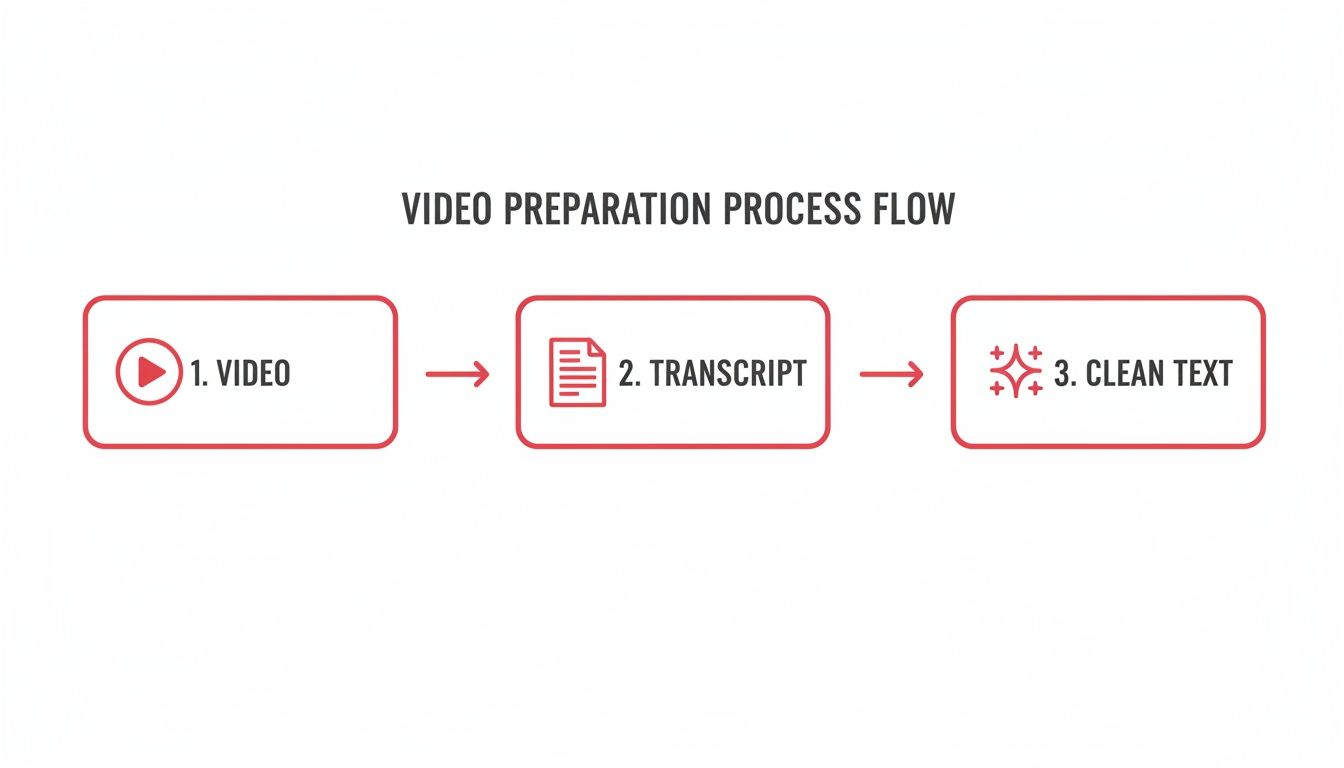
As the chart implies, the quality of your subtitles is directly tied to the quality of your initial transcript. That’s why spending a little extra time on cleanup is always worth it.
Choosing Your Greek Translation Method
Once your text is ready, you have to decide how to translate it. This is a critical step, as automated tools have come a long way, but they aren't all created equal—especially for a grammatically rich language like Greek.
Your choice of translation method will heavily influence the quality and authenticity of your Greek subtitles. To help you decide, here's a quick comparison between using an automated service and hiring a professional.
Choosing Your Greek Translation Method
| Feature | Machine Translation (e.g., Google Translate) | Professional Human Translation |
|---|---|---|
| Speed | Nearly instantaneous. You can translate a full script in seconds. | Slower. A professional needs time to translate, review, and edit. |
| Cost | Often free or very low-cost, especially when integrated into other tools. | A significant investment. Priced per word, per minute, or per project. |
| Accuracy | Varies. Good for literal meaning but can miss context, idioms, and nuance. | High. Captures cultural context, tone, and complex expressions accurately. |
| Cultural Nuance | Lacking. Cannot adapt humour, slang, or culturally specific references properly. | Excellent. A native speaker understands cultural nuances and can adapt the content naturally. |
| Best For | Quick, informal content; getting the general gist of a video; initial drafts. | High-stakes content; marketing materials; videos where brand voice and accuracy are crucial. |
Ultimately, many creators find a hybrid approach works best for maximum productivity. Start with a high-quality machine translation to do the heavy lifting, then have a native Greek speaker review and refine it.
A solid machine translation can get you 80-90% of the way there. That final 10-20% is where a human touch adds the cultural relevance and polish that separates a good translation from a great one.
When you think about the source material, it's helpful to consider the whole creation process. For instance, if you were starting from scratch, a Text To Video generator could produce a video based on your script, giving you a perfectly aligned foundation for your translation work.
At the end of the day, an efficient workflow is key. Keeping your transcription, translation, and subtitle creation within one ecosystem saves a ton of time and hassle. If you want a deeper dive into the technical side, our guide on converting TXT files to SRT is a great resource. With the right process, you can get professional-grade Greek subtitles ready in a fraction of the time it used to take.
Ensuring Your Greek Subtitles Feel Natural

Let’s be honest: a direct machine translation rarely hits the mark. Getting your video technically translated to greek is the easy part. The real challenge—and the problem we need to solve—is making it feel like it was created for a Greek audience in the first place.
This final quality check is where you elevate your content from a simple translation to genuine localisation. It’s about so much more than fixing grammar; it’s about forging a real connection.
When subtitles come across as robotic or too literal, they immediately create a disconnect. A native speaker will spot that "off" feeling in a heartbeat, which can undermine your message and make your content seem amateurish.
Going Beyond a Literal Translation
Your mission here is to ensure the translation truly captures the tone, intent, and cultural subtleties of your original video. A word-for-word translation often sounds clunky and can even lose the original meaning entirely, especially when it comes to humour or idioms.
Just think about common English phrases like "break a leg" or "bite the bullet." Translate those literally into Greek, and you'll just get confused looks. The job of a human reviewer is to find the Greek equivalent that carries the same feeling and meaning, not just a carbon copy of the words.
So, when you're reviewing, keep an eye on these key areas:
- Idiomatic Expressions: Does the translation use common, natural Greek idioms, or is it stuck on awkward, literal phrases?
- Cultural References: Are there mentions of celebrities, places, or events that a Greek audience won't get? These might need a little tweaking or a brief explanation to land properly.
- Tone and Formality: The language has to match the video's vibe. A casual, chatty vlog requires a totally different style of Greek than a formal academic lecture.
The difference between translation and localisation is the difference between being understood and being felt. Localisation builds trust by showing you’ve made an effort to speak the audience’s cultural language, not just their verbal one.
A Practical Checklist for Quality Control
Before you hit publish, it’s crucial to run your Greek subtitles through one last check. Ideally, you’d have a native speaker do this, but even with a basic grasp of the language, you can spot some of the most common red flags.
Remember who you're talking to. While Greek is the mother tongue for 95% of Greece's 10.7 million residents, you have to account for different dialects and digital literacy levels. For instance, EU data on the nuances of the Greek language landscape shows that digital proficiency among Greeks aged 65-74 drops to just 32%. This highlights why clear, simple, and accessible content is so important, especially for older viewers.
This context makes your final review even more vital. Here’s what to zero in on:
- Clarity and Flow: Try reading the subtitles out loud. Do they sound like something a person would actually say? Or are the sentences clunky and difficult to follow?
- Consistency: Have you used the same translation for key terms throughout the video? Jumping between different words for the same concept is a sure-fire way to confuse your audience.
- Contextual Accuracy: Does the translation actually fit what’s happening on screen? A word might be technically correct, but completely wrong for the specific visual context of a scene.
Putting in a little extra time at this final stage makes all the difference. It ensures your video doesn't just have Greek subtitles—it has subtitles that genuinely connect.
Expanding Your Reach Beyond Greece
Once you've got your video content professionally translated to Greek, don't stop there. The journey doesn't have to end at the borders of Greece. The Greek language is a key that unlocks doors to a much wider, global community, including neighbouring countries and the massive Greek diaspora spread across continents.
Thinking globally about your translated content can transform what seems like a simple accessibility feature into a powerful strategy for international growth. This is especially true in regions where Greek is widely understood, even if it's not the primary language.
A Gateway to the Balkans
Take a country like North Macedonia, for instance. It shares a border and significant economic ties with Greece. While Macedonian is the official language, the country is home to many linguistic groups, with the 2002 census identifying large minorities of Albanian and Turkish speakers.
It's a complex communication environment, and offering your content with Greek subtitles can create a common ground for cross-border education, business, and cultural exchange. You can get a better sense of the languages spoken in North Macedonia on Wikipedia. This simple strategy makes your content far more inclusive and can seriously broaden your viewership in the Balkan region.
Connecting with the Greek Diaspora Worldwide
Beyond neighbouring countries, you have millions of people of Greek descent living all over the world. You’ll find huge communities in places like the United States, Australia, Germany, and Canada. This global diaspora is always actively looking for content that connects them to their cultural heritage and language.
Your translated videos can become an invaluable resource for them. Whether it’s for entertainment, education, or just staying in touch with their roots, you're providing something they genuinely want.
By making your content accessible in Greek, you're not just reaching a country; you're reaching a global culture. This approach allows creators, marketing teams, and educators to engage with communities that are eager for high-quality content in their native language.
This global mindset is crucial for getting the most out of your translation efforts. Each video becomes an asset that can perform well in multiple international markets at the same time.
If you want to dive deeper into the entire workflow, from start to finish, our complete guide on how to translate a Youtube video is the perfect next step. By thinking beyond a single country, you turn your translation investment into a long-term tool for building a dedicated, international audience.
Answering Your Greek Video Translation Questions
If you're new to translating videos into Greek, you probably have a few questions. Getting it right means more than just swapping out words; it's about making sure your message truly lands with a Greek-speaking audience. Let's solve some of the most common problems creators face.
First off, how accurate is this whole process? It all hinges on the initial transcription. If you start with clear audio, a good AI tool can hit over 95% accuracy. This step is critical—a clean transcript means a clean translation. Garbage in, garbage out, as they say.
Using a service like YoutubeToText.ai for this part is a game-changer. It sets a solid foundation and boosts your productivity by saving you from fixing countless tiny errors before you even get to the Greek translation.
Can I Just Use Machine Translation?
This is the big question, isn't it? For a quick, internal-only video, sure, modern machine translation can give you the gist. It’s fast and gets a rough draft on the screen.
But if this is for your brand, for marketing, or for any kind of professional content, you absolutely need a native Greek speaker to review it. AI translators are notoriously bad with idioms, cultural references, and subtle humour. They translate words, but they often miss the feeling.
A human check is what turns a clunky, literal translation into something that feels natural and authentic. It's the step that ensures your message connects with your Greek audience, instead of just being technically understood.
What's the Deal with SRT and VTT Files?
You'll see these two file types everywhere. Both SRT (.srt) and VTT (.vtt) are simple text files that pair your translated subtitles with the video's timing. Think of them as the standard script for captions on any video platform.
Here's the simple difference:
- SRT (SubRip Text): This is the old reliable. It’s the most basic and widely supported format out there. If you need something that just works everywhere, from Youtube to an old media player, SRT is your go-to.
- VTT (WebVTT): This is the more modern version built for the web. Its main perk is that it allows for basic styling—you can add bold, italics, or even colours to your subtitles directly within the file.
Honestly, for most people, it doesn't matter which you choose. Youtube and other major platforms handle both perfectly. A tool like YoutubeToText.ai makes it even simpler by letting you download your finished subtitles in either format with one click. No technical fiddling required.
How Long Does This All Take?
The timeline really depends on your workflow. The AI part—transcribing and getting that first machine translation—is incredibly fast. We're talking minutes. This is a massive productivity win.
The human review is where the time varies. For a professional to properly review a 10-minute video, you should budget anywhere from 30 to 60 minutes. It's not just about proofreading; it's about checking flow, tone, and cultural fit. That relatively small time investment is what guarantees a polished, professional result that people will actually want to watch.
Ready to get your content in front of a Greek audience? With YoutubeToText, you can get accurate transcripts and subtitles in just a few minutes. Give it a try for free and see how simple it is to expand your reach.