Unlock your show's potential with this guide to creating a transcript of podcast content. Boost SEO, accessibility, and repurposing with proven methods.
A Podcaster’s Guide to Creating a Transcript of Podcast Content
A transcript of podcast audio is the complete, word-for-word text version of everything spoken in your episode. Think of it less like a summary and more like the full script of your show, created after you’ve recorded.
This simple text document solves a major problem for podcasters: it turns your spoken words into a searchable, accessible, and incredibly flexible asset that opens up a whole new world of growth for your show. By making your content discoverable and repurposable, you're not just creating episodes; you're building a content engine.
What Is a Podcast Transcript?
Picture your podcast as a fantastic book, packed with great stories, expert advice, and fascinating interviews. Without a written version, that book is only available to people who can listen to it. A transcript of your podcast is the key that unlocks it for absolutely everyone.
It’s a complete, verbatim record of the entire conversation. This simple text file might seem basic, but it’s a powerful tool that bridges the gap between your audio content and the text-based world of the internet. It solves the problem of discoverability for search engines, removes accessibility barriers for people with hearing impairments, and offers a convenient alternative for those who prefer reading.
The Foundation for Audience Growth
Creating a transcript is one of the single best first steps you can take to solve the problem of audience stagnation. It sets the stage for a more inclusive, productive, and discoverable show because you’re suddenly catering to different needs and habits.
Here’s how it helps you grow:
- Solve for Accessibility: You instantly make your content available to the deaf and hard-of-hearing community. It also helps non-native speakers who might find it easier to read along than to follow a fast-paced conversation. This isn't just good practice; it's a way to connect with a loyal, underserved audience.
- Solve for Discoverability: This is a big one. Google can’t listen to your audio, but it can crawl and index text like a champ. A full transcript turns your episode into a keyword-rich article that can start ranking in search results, solving the problem of how new listeners find your show.
- Enhance Productivity & User Experience: Transcripts give your listeners a way to quickly find a specific part of the conversation, check a fact, or grab a quote they loved. No more endless scrubbing through the audio file to find that one golden nugget. This respects their time and improves their experience.
The image below really drives home how a transcript has become a core part of the modern podcasting workflow, a tool for productivity as essential as the microphone itself.
Just like the microphone, the transcript is now an essential piece of the puzzle. The need for this is growing right alongside the podcast market itself. In the Netherlands, for instance, a staggering 27% of consumers listen to podcasts for at least an hour every week. Transcripts are the key for creators to connect with those millions of listeners in more effective ways.
Of course, this idea isn't just for podcasts. You can easily transcribe video into text and get many of the same benefits. And if you're looking to go deeper on content creation strategies, you can explore the BuddyPro blog for more insights.
Unlock Growth with a Transcript of Podcast Episodes
 A transcript of podcast episodes does so much more than just turn your audio into words on a page. Think of it as a key that unlocks the full potential of your show, turning each episode into a powerhouse for growing your audience. Every time you publish an episode, you're creating a valuable asset. Adding a transcript multiplies that value, solving problems related to discoverability, inclusivity, and content creation.
By simply converting your spoken words into a text document, you're essentially building a bridge between your audio and the vast, text-based world of the internet. This one simple move can drive real, tangible results, helping your podcast grow from a passion project into a core part of your brand.
Boost Your Search Engine Optimisation
Let's face it: search engines like Google are fantastic at reading text, but they can't listen to your audio files. Without a transcript, you have a discoverability problem. All the incredible insights, expert interviews, and brilliant stories you share are completely invisible to them. It's like having a library full of amazing books with blank covers.
When you publish a full transcript of podcast episodes on your website, each show instantly becomes a long-form, keyword-rich article. Every single word you spoke is now content that search engines can crawl, understand, and rank. This means people can find your show not just by browsing podcast apps, but by simply searching on Google for the exact topics you're an expert in.
A transcript is the single most effective SEO tool for a podcaster. It makes your audio discoverable, turning listeners into website visitors and website visitors into new subscribers.
Expand Your Accessibility and Reach
Making your show more inclusive isn't just the right thing to do; it's a smart way to grow your audience. A transcript immediately solves an accessibility problem for people who are deaf or hard of hearing, a community that is often left out of the audio-first world.
But the benefits don't stop there. Transcripts also help non-native speakers who might find it easier to read along and grasp complex ideas in text. They're also perfect for people in loud places, like commuters on a train, or even just for those who prefer to read and scan for the highlights instead of listening. By offering a text version, you're rolling out the welcome mat for a much wider, more diverse audience.
Supercharge Your Content Repurposing
One of the biggest hurdles for any creator is the constant need to produce fresh, high-quality content. A transcript is a goldmine for this, solving the "what to post" problem. Think of a single podcast episode as a block of marble; the transcript is your chisel, allowing you to carve out dozens of new pieces of content with minimal effort.
From just one transcript, you can quickly spin off a whole host of assets:
- Blog Posts: The transcript itself is the perfect foundation for a detailed article. Just clean it up, add some headings, and you're good to go.
- Social Media Snippets: Pull out those punchy quotes, surprising stats, or key takeaways for quick, engaging posts on X, LinkedIn, or Instagram.
- Email Newsletters: Share a summary of the main points or a particularly insightful excerpt to give your subscribers a taste of the full episode.
- Quote Graphics: Design eye-catching images featuring powerful quotes from your guest or yourself to share across your social channels.
This strategy is especially powerful in busy markets like the Netherlands, where top podcasts get huge download numbers. Transcripts help those creators capture and engage their audience on every platform, not just in their podcast feed. To get a better sense of listenership, you can dive into some global podcast listener trends. It’s all about making your content work smarter, not harder.
Here’s a quick breakdown of why transcripts are such a game-changer.
Benefits of Podcast Transcripts at a Glance
| Benefit Area | Primary Advantage | Example Application |
|---|---|---|
| SEO & Discoverability | Solves the problem of being invisible to Google by making audio content searchable. | A user searching for "sustainable marketing tips" finds your podcast episode on the topic via your transcript blog post. |
| Accessibility & Inclusivity | Opens your content to the deaf/hard of hearing and non-native speakers. | A deaf user reads the full interview with an industry leader, becoming a loyal follower of your brand. |
| Content Repurposing | Creates dozens of content pieces from a single episode, solving the content creation bottleneck. | You pull five key quotes from a 45-minute interview to create a week's worth of social media posts. |
| Audience Engagement | Caters to different learning/consumption preferences, improving user experience. | A commuter on a noisy train reads the transcript instead of skipping the episode, absorbing all the key information. |
Ultimately, providing a transcript elevates your podcast from a simple audio file to a versatile and powerful marketing asset for your brand.
Your Guide to Creating a Transcript of Podcast Audio
So, you're sold on the idea of having a transcript for your podcast. That's the easy part. The next question is, how do you actually solve the problem of getting one efficiently?
What used to be a painfully slow and often expensive task is now easier than ever. You don't need a huge budget or a team of assistants to make it happen. Really, it all comes down to a simple trade-off between your time, your money, and how perfect you need the final text to be.
You've got three main ways to go about this. Each one strikes a different balance between speed, cost, and accuracy, so the "best" choice really depends on what you need the transcript for.
The Three Main Transcription Paths
Let's break down your options.
The DIY Method (Manual Transcription): This is the old-school approach. You, or someone you hire, literally sit down, listen to the audio, and type out every single word. It’s as straightforward as it sounds, but it’s also a massive time sink. We’re talking about four to five hours of typing for just one hour of audio. While you can get a very accurate result this way, it's just not a practical solution for most podcasters who are trying to get an episode out every week.
Hiring the Pros (Human Transcription Services): This is where you hand your audio file over to a company that employs professional transcribers. They're experts at this, delivering incredibly high accuracy—often over 99%. They can easily handle tricky audio with multiple speakers, background noise, or a lot of technical jargon. The catch? This level of quality costs more, usually priced per minute of audio, and you'll typically have to wait a day or two to get it back.
The Modern Way (Automated AI Transcription): This is where technology really changes the game. Automated services use artificial intelligence to listen to your audio and convert it into text almost instantly. This approach solves the transcription problem for most creators, offering a fantastic blend of speed, affordability, and surprisingly good accuracy.
The Rise of AI-Powered Transcription
For most podcasters, AI tools are the answer. They've made getting a transcript of a podcast episode something you can do in minutes, not hours. It’s the perfect middle ground: fast, cheap, and more than accurate enough for things like boosting your SEO, improving accessibility, and creating new content from your episode.
Tools like YoutubeToText.ai are built specifically for this. They keep things simple so you can solve your transcription needs without a fuss.
As you can see, it's often as easy as just pasting a link. This kind of efficiency means anyone, from a solo creator in their bedroom to a large marketing team, can easily make transcription a standard part of their process without adding a ton of extra work or cost.
For the vast majority of podcasters, automated AI transcription is the smartest choice. It provides the speed and scalability needed to consistently turn every episode into a valuable text-based asset without breaking the budget.
While doing it by hand gives you total control and hiring a service guarantees quality, the sheer convenience and speed of AI have made it the go-to option for a reason. It lets you get back to what you do best—creating amazing audio—while the tech does the heavy lifting in the background.
Choosing the Right Transcription Method for Your Show
So, you're ready to get a transcript for your podcast. Great move! But which path should you take? Picking the right way to create a transcript of podcast episodes isn't a one-size-fits-all deal. The best approach really depends on your show's goals, your budget, and the kind of content you create.
Making the wrong choice can mean wasted time or money. The right one, however, slots perfectly into your workflow and solves your specific problem.
Essentially, your decision boils down to balancing three things: accuracy, speed, and cost. There's no single "best" method, only the one that's best for you.
Think of it this way: a true-crime podcast dissecting sensitive legal details absolutely needs the near-perfect precision you'd get from a professional human service. Here, accuracy is non-negotiable, and the higher cost is a smart investment. But if you host a weekly interview show and your main goal is to quickly spin off clips for social media, the speed and efficiency of an AI service is the obvious solution to your productivity needs.
Finding Your Perfect Match
To make the choice easier, just ask yourself: what’s my biggest priority right now?
Are you on a tight deadline and need a transcript yesterday for your show notes? Is your content packed with technical jargon that might confuse an automated system? Or is your main goal simply getting a text version online ASAP for a quick SEO boost?
To get the job done, you might look into a dedicated podcast transcription tool, as these can seriously speed up the conversion process.
This decision tree gives you a visual guide for choosing between manual, AI, and human transcription based on what you value most.
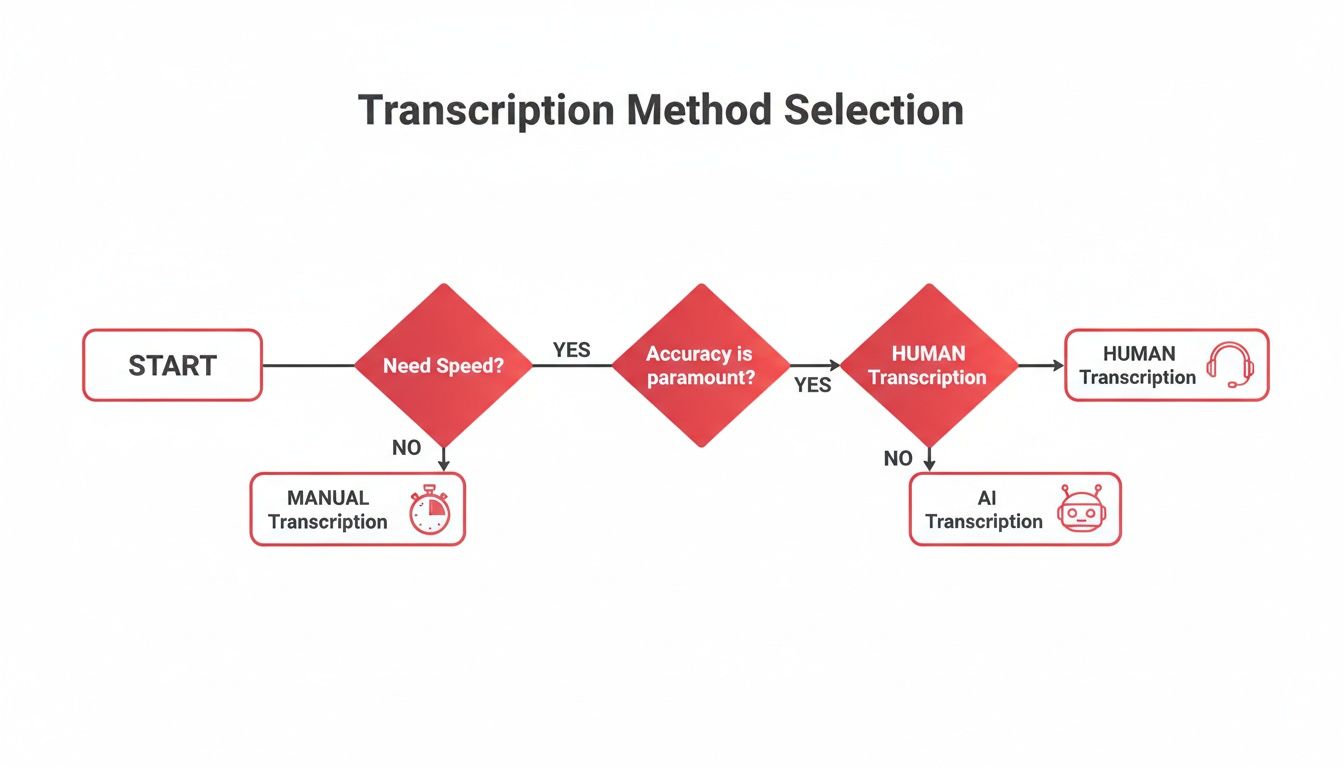
As the chart shows, if speed and repurposing content are your top concerns, AI transcription is almost always the most logical path.
And the need for this is only growing. The podcast market in Europe is expected to see a massive 33.63% CAGR between 2025 and 2033, with the Netherlands playing a big part in that boom. This surge means more and more creators are using transcripts to make their content accessible and work harder for their marketing.
A Comparative Look at Your Options
Let's break down the different methods side-by-side. Seeing the trade-offs clearly will help you pick the option that fits your strategy. If you want to go even deeper, you can learn more about converting audio to text in our comprehensive guide.
Here’s a detailed comparison of the different ways to get a podcast transcript, which should help you choose the best fit for your budget and needs.
Comparing Podcast Transcription Methods
| Method | Accuracy | Speed | Cost | Best For |
|---|---|---|---|---|
| Manual (DIY) | High (with effort) | Extremely Slow (4-5 hours per audio hour) | Free (but costs time) | Creators with more time than money needing absolute precision for a single project. |
| AI Service | Good to High (85-98%) | Extremely Fast (minutes) | Low (often free or affordable subscription) | Most podcasters, marketers, and creators needing speed and scalability for SEO and content repurposing. |
| Human Service | Very High (99%+) | Slow (24-48 hours) | High (per audio minute) | Projects requiring legal-grade accuracy, complex audio with multiple speakers, or medical/technical content. |
By weighing your needs against this table, you can confidently pick the transcription method that will serve your podcast best and help you hit your growth targets.
How to Polish Your Transcript for Maximum Impact
 An automated transcript is a brilliant head start. It gives you all the raw material you need in just a few minutes, but it's not quite the finished article. A little bit of polish can transform that rough draft into a professional, easy-to-read piece that genuinely helps your audience and boosts your brand.
Think of it like the final edit before a book goes to print. This isn't about rewriting your entire episode from scratch. It’s about making a few smart, targeted tweaks to make the transcript of podcast audio much more readable and user-friendly. Honestly, even a quick 15-minute review can make a massive difference.
Enhancing Readability and Structure
First things first, let's clean up any obvious mistakes. Automated tools are incredibly good, but they sometimes trip over unusual names, specific company terms, or niche jargon. A quick scan to fix these little errors is all it takes to make your content look professional.
Next, it's all about the structure. Nobody wants to face a giant wall of text; it's overwhelming and difficult to follow. Your job is to make the content scannable and inviting for people who'd rather read than listen.
- Break Up Paragraphs: Keep your paragraphs short and sweet—two or three sentences is perfect. This creates plenty of white space and makes the text far easier to digest on any device.
- Add Speaker Labels: If you have multiple speakers, make it crystal clear who's talking. Using simple labels like "Host:" or "Dr. Evans:" removes any guesswork and helps readers follow the flow of the conversation.
- Use Subheadings: Just like in a good blog post, subheadings act as signposts. They guide the reader through the main topics of your episode, breaking up the text and helping them find exactly what they're looking for.
Adding Value with Timestamps and Formatting
Once you've nailed the basics, you can add a few extra touches to make your transcript even more useful. These small additions can really encourage people to engage more deeply with both the text and your original audio.
Adding timestamps is one of the most powerful ways to connect your transcript back to your audio. It allows readers to jump directly to a specific moment in the podcast to hear the original tone and context.
For instance, placing a timestamp like [00:15:32] next to a powerful quote lets a user instantly click and listen to that exact highlight. It’s a simple but effective way to bridge the gap between reading and listening.
Don't forget to use formatting to your advantage. Use bold text for important takeaways or surprising statistics to make them pop. You can even take your polished text a step further and turn it into timed captions. To get the hang of that, check out our guide on converting TXT to SRT. These edits turn a simple text file into a genuinely valuable, interactive resource for your audience.
Ethical and Legal Guidelines for Using Transcripts
It’s one thing to have a transcript, but it’s just as important to know how to use it responsibly. Getting a handle on the basic ethical and legal rules isn’t just about avoiding trouble; it’s about building trust with your audience and respecting the work that goes into creating content.
First things first: who owns what? The moment someone records a podcast, they own the copyright to that audio. That copyright also extends to a word-for-word transcript. So, if you're transcribing your own show, you’re in the clear. Go ahead and turn it into a blog post, pull out quotes for social media, or even compile episodes into an ebook. You hold all the cards.
Giving Credit Where It’s Due
But what if you're transcribing someone else's podcast, maybe for a research project or to add commentary on your own blog? This is where attribution becomes non-negotiable. It’s the difference between sharing and stealing, and it's a cornerstone of respecting intellectual property.
Think of it exactly like quoting a book in an essay—you have to cite your source. A solid, clear attribution is simple. Just make sure you include:
- The name of the podcast
- The title or number of the episode
- The host's name
- A direct link back to the original episode
By always giving clear credit, you're not only doing the right thing, but you're also pointing your own audience to other great content. It's a small act that supports the entire creator community.
One last point to consider is privacy. If your podcast involves guests or interviewees, it's a good idea to let them know a public transcript will be available. This simple heads-up maintains transparency, protects everyone involved, and keeps the trust you've built with your guests intact.
Frequently Asked Questions About Podcast Transcripts
Jumping into the world of podcast transcripts usually sparks a few questions. Let's clear up some of the most common ones so you can get started with confidence.
How Long Does It Take to Get a Transcript?
That really comes down to the method you choose. If you decide to type it out yourself, be prepared for a serious time commitment. Manually transcribing just one hour of audio can easily take four to five hours of focused work.
Hiring a professional human service is much quicker, usually getting you a polished transcript back within 24 to 48 hours. But if speed is what you're after, nothing beats AI. Automated tools can turn an hour-long podcast into a full transcript in just a few minutes.
Should I Publish the Full Transcript on My Website?
Yes, you absolutely should. Putting the full transcript of a podcast on your website is a huge win for your SEO. Think about it: each episode page instantly becomes a detailed, keyword-rich article that search engines like Google can easily find and rank, bringing new listeners right to your digital doorstep.
For the best of both worlds—great SEO and a clean design—try putting the full transcript inside a collapsible "accordion" menu on the page. It keeps your layout tidy while making sure all that valuable text is there for search engines and visitors who want it.
This way, you get all the search benefits without hitting visitors with a giant wall of text the moment they land on the page.
What Is the Difference Between a Transcript and Show Notes?
It's a simple distinction but a crucial one. A transcript is the complete, word-for-word text of everything said in your podcast episode. Every sentence, every "um," every aside—it's all there.
Show notes, however, are more like a summary. They give your listeners the highlights, key takeaways, and links to resources or guests mentioned in the show. While both are useful, a transcript is what gives you the deep SEO and accessibility benefits, whereas show notes are for a quick overview.
Ready to unlock your podcast's full potential? With YoutubeToText, you can get a fast, accurate transcript of your podcast in minutes. Transform your audio into searchable, shareable, and repurposable content today by visiting https://youtubetotext.ai.