Discover how a transcript for podcast can boost your show’s SEO, accessibility, and reach. Learn simple methods to create and use transcripts effectively.
A Podcaster's Guide to Creating a Transcript for Podcast Success
A transcript for podcast episodes is simply a written version of everything said in your show. Think of it as turning your audio conversation into a readable, searchable document. It’s the key that unlocks a whole new level of potential for your content, solving key challenges in audience growth, accessibility, and content creation.
What Is a Podcast Transcript and Why It Matters Now More Than Ever
For a long time, podcasters treated transcripts as a nice little extra—a bonus feature, but hardly essential. That thinking just doesn't work anymore. With millions of podcasts vying for attention, a transcript is no longer an afterthought. It's a fundamental tool for solving the critical problems of discoverability and accessibility, inspiring you to find new ways to grow your audience. It literally builds a bridge from your audio-only world to the text-driven internet.
Without a transcript, your podcast is basically invisible to search engines like Google. They can't "listen" to your audio files to figure out what you're talking about. This is a huge problem: all those valuable insights, expert interviews, and great stories stay locked away from people who are actively searching for your topics online.
Turning Audio into Opportunity
Having a transcript for your podcast episodes completely changes the game. It’s not just about converting sound into words on a page; it's about solving the problem of limited content value by squeezing every drop of potential out of a single recording.
By offering a written version, you immediately open your show up to a much wider audience. This solves a major accessibility issue, welcoming people who are deaf or hard of hearing, non-native speakers who find it easier to read than listen, and anyone in a situation where playing audio isn't an option, like a noisy commute or a quiet office.
A transcript is the single most effective tool for making your podcast searchable, accessible, and repurposable. It takes your audio content out of its silo and integrates it with the wider web, creating endless opportunities for growth and solving the challenge of discoverability.
On top of that, a transcript is the starting point for any smart content repurposing strategy, solving the problem of "what else can I create?" Imagine taking a single one-hour interview and turning it into a series of blog posts, dozens of social media quotes, a detailed email newsletter, or even a short eBook. That whole process begins with having the conversation written down.
Standing Out in a Competitive Market
The podcasting universe has exploded, and so has the demand for high-quality, easy-to-access content. This boom is driving huge growth in related fields. The AI transcription market, for instance, is expected to jump from $4.5 billion to $19.2 billion by 2034, fuelled by a global audience of over 584 million listeners. You can learn more about these insights into the Dutch podcast market.
This surge means the competition is intense. There are over 4.5 million podcasts out there, but only a small number stay active. Creators need every advantage they can find. Simply providing a transcript is a powerful way to stand out, showing you’re professional and truly care about your audience. It tells people you're serious about creating valuable, accessible content, which is exactly how you build a loyal community in such a crowded space.
Unlock Growth with These Core Transcript Benefits
A podcast transcript is so much more than just a wall of text. Think of it as a multi-purpose tool that actively fuels your show's growth. When you turn your audio into a readable format, you solve some of the biggest challenges podcasters face and open up powerful ways to expand your reach that are completely impossible with audio alone.
Let's dive into how providing a transcript for podcast episodes can shift your content strategy from a simple broadcast into a proper growth engine. Each of these benefits solves a genuine problem and unlocks new chances to connect with your audience.
Boost Your Discoverability with SEO
Search engines like Google are incredible at reading text, but they can't listen to audio. This creates a huge discoverability problem: without a transcript, all the juicy stuff in your podcast—every keyword, every expert insight, every brilliant story—is completely invisible to them.
Imagine you just released a fantastic episode on "sustainable gardening tips." Someone searching for that exact phrase will only find blog posts and articles, not your audio. By publishing a transcript, you give search engines a full, text-based version of your show to crawl, index, and rank, directly solving this issue.
This simple act of putting text alongside your audio can seriously increase your organic traffic. Suddenly, every topic you discuss becomes a potential doorway for new listeners finding you through a simple Google search.
Your podcast can now start competing for valuable search rankings, pulling in an audience that is actively looking for the information you’re providing. You're no longer just relying on podcast directories to be found; you've got the world’s biggest discovery engine working for you.
Make Your Content Accessible to Everyone
Accessibility isn't just a box to tick; it’s about being inclusive and solving the problem of exclusion for all potential listeners. A huge portion of the global population faces barriers that stop them from enjoying audio-only content.
A podcast transcript smashes through these barriers in a few key ways:
- Deaf and Hard of Hearing Audience: For anyone with a hearing impairment, a transcript isn't just helpful—it's the only way they can access your content. You instantly open your show up to an entire community that was previously left out.
- Non-Native Speakers: Lots of people find it easier to read a language than to understand it being spoken, especially with different accents or fast-paced chats. A transcript lets them follow along and fully get your message.
- Situational Limitations: Think about someone on a loud train or in a quiet office. They can't exactly blast your podcast through headphones, but they can easily read a transcript on their screen.
By offering a text version, you show a real commitment to inclusivity, which builds goodwill and broadens your potential audience. You’re making it clear that your content is for everyone, no matter their circumstances.
Simplify and Amplify Your Content Repurposing
Coming up with original content takes a lot of time and effort. A podcast transcript is a goldmine for repurposing, solving the productivity problem of "creator burnout" by letting you multiply the value of every single episode with very little extra work. It’s the raw material for a whole new range of content.
Once you have the text, you can easily reshape it. A single hour-long interview can become:
- A Detailed Blog Post: Use the transcript as your foundation, add some headings and pictures, and you've got a comprehensive article ready to go.
- Social Media Snippets: Pull out powerful quotes, key stats, or funny anecdotes to create dozens of engaging posts for X, LinkedIn, or Instagram.
- Email Newsletters: Summarise the key takeaways from an episode and send them to your subscribers, driving them back to your podcast and website.
- Lead Magnets: Bundle a few related transcripts into a short eBook or guide that you can offer people in exchange for their email address.
This strategy maximises your creative output. Instead of constantly trying to come up with new ideas, you can focus on spreading the valuable insights you’ve already created across more channels, reaching new audiences where they hang out. This is how you build a powerful and efficient content machine.
How to Choose the Right Transcription Method for Your Podcast
So, you're sold on creating a transcript for your podcast. The next big question is: how do you solve the challenge of getting it done?
Good news—you’ve got a few solid options. Each one offers a different mix of cost, speed, and accuracy. The right choice really comes down to your budget, your deadline, and how polished you need that final text to be.
Think of it like getting dinner. You could cook it yourself from scratch (manual transcription), giving you total control but taking a while. You could use a meal-kit delivery service (automated transcription), which is super fast and cheap but might need a little seasoning. Or, you could hire a private chef (a professional service) for a perfect result that costs a bit more.
The Manual, Do-It-Yourself Approach
Manual transcription is exactly what it sounds like. You, or someone on your team, sit down with a pair of headphones and type out the entire episode word-for-word as you listen. It’s a hands-on method that gives you complete control over the final document.
The biggest plus here is unmatched accuracy. You can catch every nuance, correctly identify who’s speaking, and make sure all that industry-specific jargon is spelled right. But that precision comes at a price: your time. Manually transcribing a one-hour podcast can easily chew up four to six hours, even if you’re a speedy typist.
The Rise of Automated AI Transcription
This is where technology really steps in to help. Automated transcription services use artificial intelligence to turn your audio into text in just a few minutes, solving the problem of time and budget constraints. For many creators, these tools have been a total game-changer, bringing a level of speed and affordability that was once out of reach. You just upload your audio file, and the AI does the heavy lifting.
AI’s role in content creation has exploded. In fact, 40% of all podcasters now use AI for tasks like this, and that figure jumps to a whopping 67% among professional creators. This is happening alongside a booming European podcast market, valued at USD 2.55 billion, which is the perfect environment for these technologies to take off. You can read more about the accelerated growth of podcast transcription technologies.
Now, while AI is incredibly fast, its accuracy typically lands somewhere between 90% and 98%. This can depend on things like your audio quality, different accents, or any background noise. For most podcasters, that’s more than good enough, especially after a quick proofread to fix any small mistakes. If you're looking for an efficient way to get this done, you might want to check out our guide on the best audio to text converters.
Professional Human-Powered Services
What if you need the highest possible accuracy but don't have the time to do it yourself? That’s where professional transcription services come in. These companies have teams of experienced human transcribers who listen to your audio and produce a nearly perfect, polished transcript, solving the need for flawless quality.
This method gives you the best of both worlds: the pinpoint accuracy of manual work combined with the convenience of outsourcing it to someone else. It's the go-to option for content where every word matters, like legal podcasts, medical discussions, or any episode you plan to turn into a book.
Of course, this premium quality comes with a higher price tag and a slower turnaround, usually between 24 and 48 hours. It's the top-shelf choice for creators who prioritise perfection and have the budget for it.
Comparing Your Transcription Options
To help you decide, let's put these three methods side-by-side. Your choice will probably boil down to what you value most: cost, speed, or accuracy.
Podcast Transcription Methods Compared
Here's a quick comparison to help you decide which path is right for you, based on what you need for speed, accuracy, and cost.
| Method | Typical Cost | Turnaround Time | Accuracy | Best For |
|---|---|---|---|---|
| Manual DIY | Free (your time) | 4-6 hours per audio hour | Up to 99.9% | Creators with more time than money who need perfect accuracy. |
| Automated AI | Low-cost subscription | Minutes per audio hour | 90-98% | Podcasters needing a fast, affordable transcript for SEO and accessibility. |
| Professional Service | Premium (per minute) | 24-48 hours | 99%+ | Professionals who require flawless transcripts and can afford to outsource. |
By weighing these factors, you can pick the transcription method that fits your workflow perfectly. That way, you get a high-quality transcript for podcast episodes without blowing your budget or your schedule.
How to Format and Publish Your Transcript for Maximum Impact
Getting your podcast transcribed is a fantastic first step, but its true power isn't unlocked until people can actually find and use it. If you just dump a wall of text on a page, you're not doing anyone any favours. Poor formatting can make even the most accurate transcript completely unreadable.
The goal is to turn that raw text into an inviting, scannable resource that actually helps your listeners and gives your SEO a serious boost. And thankfully, it's not about complex coding or fancy design. Simple tweaks like clear speaker labels, adding timestamps, and breaking up long paragraphs make all the difference.
This little decision tree can help you figure out which transcription method is right for you, depending on whether you're prioritising cost, speed, or pinpoint accuracy.
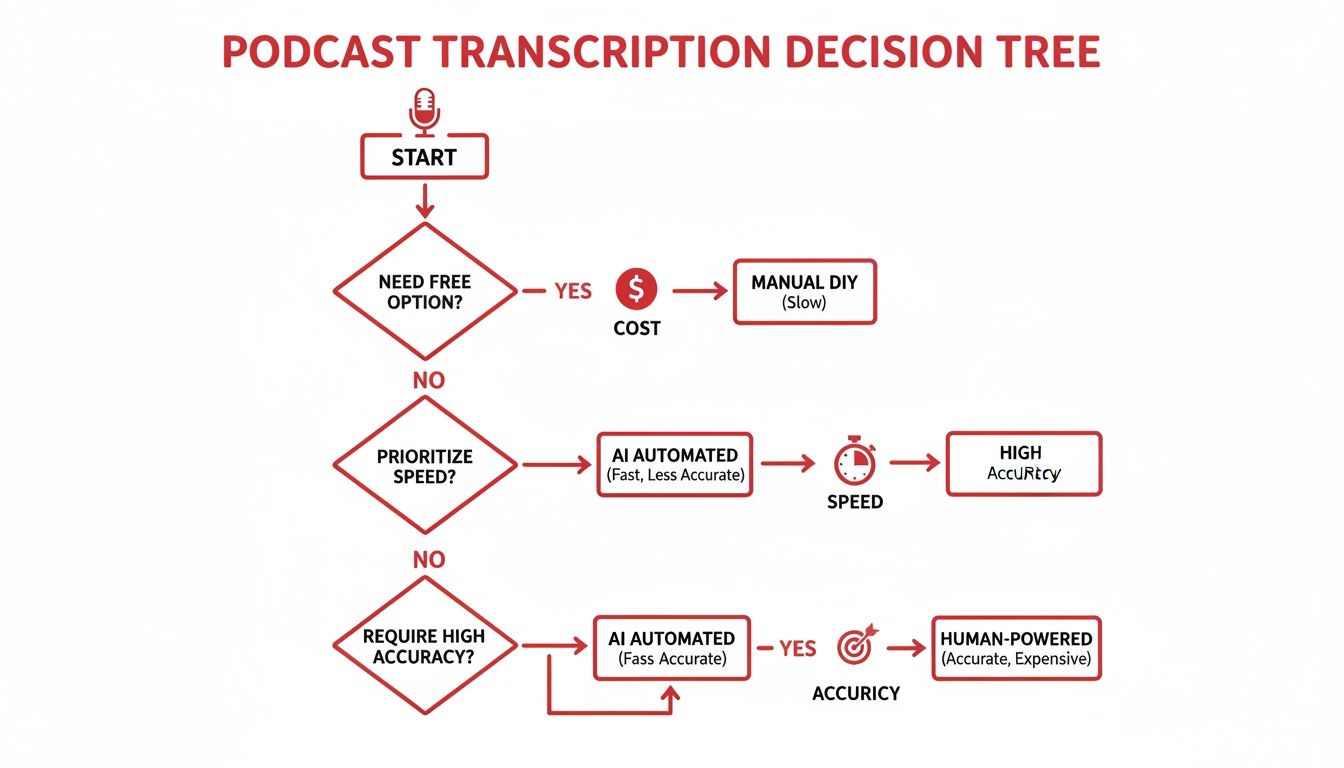
As you can see, AI tools are your go-to for speed and keeping costs down. But if accuracy is the most important thing, a professional service is probably the way to go.
Best Practices for Formatting Your Transcript
To make your transcript something people actually want to read, let’s focus on a few key formatting principles. These simple practices help your audience follow along, find what they need, and stay engaged.
First up, always use distinct speaker labels. Just putting a name in bold (like Anna: or Mark:) before someone speaks makes a conversation a million times easier to follow. Without them, it's just a confusing mess of words.
Next, pepper in some timestamps at logical points. Adding a clickable timestamp like [00:15:30] every few paragraphs is a game-changer. It lets people jump right to that specific moment in the audio, which is brilliant for anyone who wants to rehear a key point or share a great quote. It tethers your text directly to the audio, creating a much better experience. For more technical uses, you can also learn about converting text files into timed formats by exploring the process of converting a TXT file to SRT.
Finally, think about scannability. Nobody enjoys staring at a giant block of text.
- Short Paragraphs: Aim for just 2-3 sentences per paragraph. It’s so much easier on the eyes.
- Headings and Subheadings: Break up the big topics from your episode with clear headings.
- Bold Key Phrases: Make important quotes or takeaways stand out by bolding them.
These little touches make your podcast transcripts far more approachable and genuinely useful.
Where to Publish Your Transcript
Okay, so your transcript is beautifully formatted. Now, where do you put it? Publishing it in the right places is crucial for reaching the widest audience and getting that sweet SEO value. There are three main spots to consider, and each one serves a slightly different purpose.
The smartest move is to publish your transcript in a few different places. A full blog post for SEO, a dropdown section in your show notes for convenience, and a downloadable PDF for your hardcore fans will cover all your bases.
One of the most powerful options is to create a dedicated blog post on your website for each episode's transcript. This gives search engines a whole new page of keyword-rich content to index, which is fantastic for helping new listeners discover you. It also becomes a central home for the episode, where you can embed your audio player and add any other relevant links or notes.
Another key location is right within your podcast show notes. Now, most podcast apps have a character limit, so you probably can’t paste the entire thing. A great workaround is to include the first few paragraphs as a teaser, then link out to the full blog post on your website. Of course, when you're publishing all this, you want to be sure the audio itself is managed well; a bit of reading on properly hosting MP3 files can go a long way.
Lastly, think about offering a downloadable PDF version. This is a nice little bonus for your audience. It gives them a portable copy they can save for later, print out, or reference offline. It’s a thoughtful touch that shows you're serious about providing value to your most dedicated listeners.
A Simple Workflow for Automated Podcast Transcription
Jumping into automated transcription is much easier than it sounds. Honestly, most modern AI tools are designed to be incredibly user-friendly, turning what used to be a technical headache into a task you can finish in just a few clicks. This simple workflow solves the problem of a complicated production process, inspiring you to make transcription a regular part of your routine.
The whole point of these tools is to make the process smooth. It’s a lot like using a simple online photo editor: you upload your picture, pick a filter, and the software does all the hard work. Creating a transcript for podcast episodes works on the same basic principle.
Getting Started with AI Transcription
The first step is always the same: uploading your audio. This is usually an MP3 or WAV file of your finished episode. Just find the file on your computer and upload it directly to the platform.
Once your file is uploaded, you’re nearly there.
- Select Your Language: First, tell the AI what language is being spoken in your podcast. This is a critical step for getting an accurate result, especially if you have guests with different accents.
- Start Transcribing: Next, you just hit the "transcribe" button, and the AI takes over. It listens to the audio, figures out what’s being said, and spits out a text document. The whole thing usually takes just a few minutes.
This first draft from the machine does all the heavy lifting and is often more than 95% accurate. If you're shopping around, it's worth checking out different AI captioning tools to see which one feels right for your workflow.
The real game-changer with AI transcription is the sheer speed. A task that once took hours of painstaking manual work can now be done in the time it takes to make a cup of tea. It completely reshapes how you think about your production schedule.
The Final Polish
The last step is a quick once-over by a human—that’s you! AI is incredibly smart, but it can still stumble over things like unique names, slang, or niche jargon. This is where you come in to catch those small errors.
- Double-check that all speaker names are spelled correctly.
- Make sure any industry-specific terms are right.
- Fix any odd punctuation that looks out of place.
This quick proofread is what takes your transcript from good to perfect, making sure it’s polished and ready to go public. If you're keen to dig deeper, our complete guide to audio to text conversion has even more tips. With this straightforward workflow, creating a transcript becomes a quick and easy part of your podcasting routine.
Frequently Asked Questions About Podcast Transcripts
Once you start thinking about adding transcripts to your podcasting routine, a few practical questions always come up. I get asked these all the time. Let's solve some common problems and clear up any confusion so you can move forward and get the most out of your transcripts.
We'll cover everything from how transcripts really affect your search rankings to silly formatting mistakes and what to do with transcripts when you have a video podcast.
Will Adding a Transcript Guarantee My Podcast Ranks on Google?
This is the big one, isn't it? The short answer is no, but it solves the most fundamental SEO problem for podcasters. A transcript won't magically shoot you to the number one spot on Google, but it's probably the single biggest thing you can do for your podcast's SEO. Think of it less as a guarantee and more like finally buying a ticket for the lottery.
Without a transcript, your podcast has literally zero percent chance of ranking for anything you talk about in an episode. Search engines can't listen to audio, so as far as Google is concerned, your audio file is a complete black box. When you publish the text, you’re finally giving it the raw material it needs to figure out what you're about and show you to people searching for your topics.
So, a transcript makes your podcast discoverable. It won't guarantee top rankings on its own—great content and a solid SEO strategy are still key—but it opens a door to organic search traffic that was completely locked before.
It’s not a magic bullet, but it takes your podcast from being invisible to search engines to being a piece of content they can actually read and index. For any podcaster serious about growth, that’s a non-negotiable first step.
What Is the Ideal Length for a Podcast Transcript?
Simple: the ideal length is the full length. Every single word. If your goal is to solve the problem of discoverability and accessibility, there’s absolutely no benefit to chopping it up or only publishing a summary. Every word you spoke is a potential keyword someone might search for.
Some people worry that a transcript for a two-hour episode will look like a massive wall of text and scare people away. That’s a fair concern, but it’s easily solved with a bit of smart formatting.
- Use Subheadings: Just like in a blog post, break up the conversation into sections based on the topics you cover.
- Hide It in a Dropdown: A simple "click to expand transcript" button (often called an accordion) keeps your show notes page looking clean while making the full text available to those who want it.
- Add a Table of Contents: For those super long, deep-dive episodes, a linked table of contents at the top is a lifesaver, letting people jump straight to the part they're most interested in.
The bottom line is to provide the complete, accurate text of your episode. Don't short-change yourself by cutting it down; just use good formatting to make it easy for people to navigate.
What Are the Most Common Formatting Mistakes to Avoid?
A badly formatted transcript can be almost as useless as having no transcript at all. The biggest mistake I see is when someone just copies and pastes the raw text from an automated service straight onto their website. It creates a horrible reading experience and cancels out half the benefits.
Here are the top three mistakes you’ll want to sidestep:
- Forgetting Speaker Labels: A conversation without knowing who is talking is just a jumbled mess. Always use clear labels (like Host: or Dr. Evans:) so people can actually follow along.
- Creating a "Wall of Text": Nothing makes a reader's eyes glaze over faster than a giant, unbroken block of words. Keep your paragraphs short and snappy—just one to three sentences each. It makes the whole thing feel so much more approachable.
- Omitting Timestamps: Timestamps (like [00:15:30]) are the bridge connecting your text to your audio. Leaving them out removes a crucial bit of functionality. They let readers click and jump to that exact moment in the audio player, which is a massive user experience win.
Avoiding these simple slip-ups will take your transcript from a messy data dump to a genuinely helpful resource that makes your podcast even better.
How Can I Use Transcripts for a Video Podcast?
For video podcasters, transcripts are an absolute goldmine. They pull double duty, working as both a standard transcript for your site and as the direct source for your video's captions or subtitles. This is huge for solving the accessibility and engagement problems inherent in video content.
The most obvious use is to turn your transcript into a subtitle file, like an SRT or VTT. These files package the text with the exact timing needed to sync the words perfectly with your video. Platforms like Youtube make uploading these files incredibly easy.
Doing this gives you a few key advantages:
- Accessibility: It immediately makes your content accessible to viewers who are deaf or hard of hearing.
- Silent Viewing: Think about how many people scroll through social media with their phone on silent. Subtitles mean your message gets through even when the sound is off. Some studies have even shown that subtitled videos on Facebook get up to a 12% increase in watch time.
- Comprehension: Captions help everyone, especially non-native speakers, follow along more easily, which keeps them watching for longer.
Beyond subtitles, you can pull the text from your transcript for podcast videos to write killer Youtube descriptions, grab powerful quotes for social media clips, and create full blog posts that embed your video, driving even more traffic from Google.
Ready to unlock the full potential of your podcast with effortless transcription? YoutubeToText automatically converts your audio and video content into accurate, searchable text in minutes. Save time, boost your SEO, and make your content accessible to everyone. Start transcribing your first episode for free today!